Before construction begins, most people focus on architectural drawings, building materials, costs and construction timelines. However, one of the most important factors influencing the success of any project is often hidden beneath the surface — the ground.
Whether you are building a new home, extending an existing property, constructing a retaining wall, developing a commercial site or planning a basement excavation, understanding soil and rock conditions is essential.
This is where geotechnical consultants play an important role.
Geotechnical consultants investigate and analyse the behaviour of soil, rock and groundwater to determine how the ground will respond to construction activities. Their expertise helps engineers, builders and property owners make informed decisions about foundations, excavation methods, drainage solutions and structural design.
Without proper geotechnical assessment, construction projects may face unexpected challenges such as foundation movement, excessive settlement, water problems, excavation difficulties and additional costs.
For property owners in Sydney and across NSW, engaging experienced geotechnical consultants before construction can reduce uncertainty and provide confidence that the project is designed according to actual site conditions.
Integra Consultants provides geotechnical engineering services for residential, commercial and civil projects, helping clients understand their site conditions and develop practical construction solutions.
What Does a Geotechnical Consultant Do?
A geotechnical consultant is an engineering professional who studies the relationship between the ground and structures.
While structural engineers focus on designing the building itself, geotechnical consultants focus on the conditions that support the structure.
Their work commonly involves:
- Investigating soil and rock conditions
- Assessing groundwater conditions
- Performing field testing
- Conducting laboratory analysis
- Evaluating foundation requirements
- Assessing excavation risks
- Providing engineering recommendations
A geotechnical consultant may prepare a geotechnical investigation report that includes information about:
- Soil profile
- Rock depth and quality
- Bearing capacity
- Settlement risks
- Site classification
- Excavation conditions
- Retaining wall requirements
- Drainage considerations
The purpose of this assessment is to ensure that construction decisions are based on reliable information rather than assumptions.
Why Ground Investigation Matters Before Construction
Every structure interacts with the ground beneath it.
A building may appear strong above ground, but if the foundation system is not suitable for the actual soil conditions, problems can develop over time.
Common ground-related construction issues include:
- Cracks in walls and floors
- Uneven settlement
- Foundation movement
- Water entering excavations
- Retaining wall failure
- Unexpected excavation costs
These problems often occur because ground conditions were not properly understood before construction started.
A geotechnical investigation provides valuable information about what exists below the surface and allows the project team to address potential issues during the design stage.
10 Reasons To Hire a Geotechnical Consultant Before Construction
1. Understand Actual Ground Conditions
One of the primary reasons to hire a geotechnical consultant is to understand what is beneath your property.
Surface observations alone cannot reveal:
- Soil layers
- Rock depth
- Ground strength
- Hidden fill materials
- Groundwater conditions
Two neighbouring properties may have completely different subsurface conditions due to previous construction, excavation history or natural geological variation.
A geotechnical consultant uses investigation methods such as:
- Boreholes
- Test pits
- Soil sampling
- Field testing
- Laboratory analysis
to develop a clearer understanding of the site.
This information helps determine whether the ground is suitable for the proposed development and what design considerations may be required.
2. Design Safer and More Suitable Foundations
The foundation is one of the most critical parts of any building.
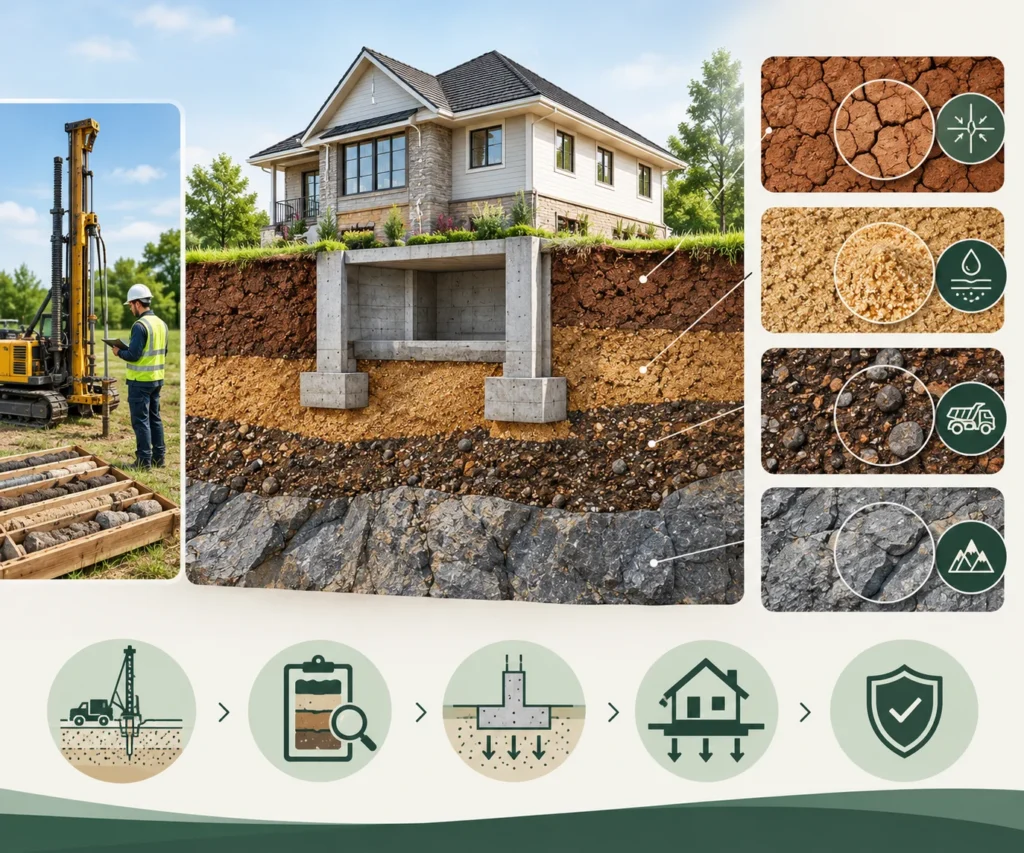
A foundation must safely transfer structural loads into the ground. However, different soils behave differently under pressure.
For example:
- Reactive clay may expand and shrink with moisture changes
- Loose sand may experience settlement
- Poor-quality fill may not provide reliable support
- Weathered rock may require specific foundation considerations
Geotechnical consultants provide information that allows structural engineers to select appropriate foundation solutions.
The investigation may help determine:
- Suitable footing systems
- Founding depth
- Allowable bearing pressure
- Settlement considerations
By designing foundations based on actual ground conditions, the risk of future movement and structural problems can be reduced.
3. Prevent Costly Construction Surprises
One of the biggest advantages of hiring geotechnical consultants before construction is reducing unexpected costs.
Many construction problems occur because underground conditions are not fully understood before work begins.
Examples of unexpected conditions include:
- Unstable soil
- Unexpected rock layers
- Groundwater during excavation
- Poor-quality fill materials
- Additional foundation requirements
- Difficult excavation conditions
For example, a project may be planned based on normal excavation assumptions, but during construction, contractors may discover hard rock that requires specialised equipment and additional time. Similarly, groundwater may require drainage systems, waterproofing measures or temporary dewatering solutions.
A geotechnical investigation identifies these risks early, allowing project teams to include realistic costs and construction methods in the planning stage.
Although a geotechnical assessment is an upfront expense, it can help prevent much larger costs caused by unexpected ground conditions during construction.
4. Identify Soil and Ground Risks Early
Every construction site has potential risks related to soil, rock and groundwater. The earlier these risks are identified, the easier they are to manage.
Geotechnical consultants evaluate potential issues such as:
- Soil movement
- Settlement risk
- Slope instability
- Erosion potential
- Weak ground layers
- Reactive soils
- Groundwater impacts
For properties in Sydney and NSW, ground conditions can vary significantly. Some sites may contain sandstone, shale, clay, coastal sands or imported fill from previous development.
Each type of ground condition can affect construction differently.
For example:
- Reactive clay may move due to seasonal moisture changes.
- Loose sand may require additional consideration for settlement.
- Fill materials may require assessment before supporting structures.
- Sloping sites may require stability analysis.
By identifying these conditions before construction begins, engineers can develop suitable solutions rather than responding to problems after they occur.
5. Improve Excavation Safety
Excavation is one of the most technically challenging parts of many construction projects.
Projects involving:
- Basements
- Underground structures
- Retaining walls
- Deep foundations
- Cut-and-fill earthworks
require careful assessment of ground behaviour.
Geotechnical consultants help evaluate:
- Soil stability
- Rock conditions
- Excavation support requirements
- Effects on neighbouring structures
- Potential ground movement
Poorly planned excavation can create risks for:
- Workers on site
- Nearby buildings
- Underground services
- Adjacent properties
A geotechnical assessment provides important information that supports safer excavation planning and construction methods.
For example, the investigation may identify whether temporary support systems, battering, underpinning or monitoring are required.
6. Manage Groundwater and Drainage Issues
Water is one of the most important factors affecting construction performance.
Groundwater, rainfall and poor drainage can influence:
- Excavation stability
- Foundation performance
- Basement construction
- Retaining wall behaviour
- Long-term building durability
Geotechnical consultants assess groundwater conditions and provide recommendations for managing water-related risks.
This may include advice regarding:
- Drainage systems
- Waterproofing requirements
- Excavation procedures
- Groundwater monitoring
- Temporary water control measures
Basement projects are particularly sensitive because excavation below ground level may encounter groundwater that was not visible during initial planning.
Identifying these conditions early allows the design team to develop appropriate solutions before construction begins.
7. Support Better Structural Design Decisions
A successful construction project requires cooperation between multiple professionals, including:
- Architects
- Structural engineers
- Builders
- Geotechnical consultants
Geotechnical information provides the foundation for better design decisions.
The findings from a geotechnical report can influence:
- Building layout
- Foundation selection
- Excavation depth
- Retaining wall design
- Construction methodology
Without reliable ground information, structural engineers may need to make conservative assumptions. While this approach can increase safety, it may also result in unnecessary construction costs. A detailed geotechnical assessment, including ground-structure interaction analyses, allows engineers to design more efficiently based on actual site conditions.
8. Meet Council and Project Approval Requirements
Many construction projects require technical documentation before approval.
Depending on the location and type of development, councils, certifiers or approval authorities may request geotechnical information.
A geotechnical report may support:
- Development applications
- Construction certificates
- Engineering documentation
- Design approvals
Projects that may commonly require geotechnical assessment include:
- New residential buildings
- Multi-unit developments
- Commercial projects
- Basement construction
- Retaining walls
- Developments on sloping land
Requirements can vary between councils, so consulting a geotechnical professional early helps ensure the correct documentation is prepared.
9. Protect Nearby Properties and Existing Structures
Construction activities can affect surrounding properties, especially in developed urban areas.
Excavation, vibration and changes to ground conditions may influence:
- Neighbouring buildings
- Existing retaining walls
- Underground services
- Boundary structures
Geotechnical consultants assess how the proposed works may interact with surrounding ground conditions.
They may provide recommendations regarding:
- Excavation support
- Monitoring requirements
- Temporary works
- Ground movement control
This is particularly important for projects involving:
- Basement excavation
- Construction close to boundaries
- Demolition and redevelopment
- Deep foundations
Early assessment helps reduce risks to both the new development and surrounding properties.
10. Improve Long-Term Building Performance
The goal of geotechnical engineering is not only to support construction but also to improve the long-term performance of a structure.
Buildings interact with the ground throughout their lifespan.
Poorly understood ground conditions may contribute to:
- Cracking
- Uneven movement
- Water problems
- Foundation distress
- Maintenance issues
A geotechnical consultant helps ensure that the building is designed with appropriate consideration of:
- Soil behaviour
- Ground movement
- Drainage conditions
- Foundation requirements
Investing in proper ground assessment before construction can contribute to a more durable and reliable structure.
Projects That Commonly Require Geotechnical Consultants
The need for geotechnical services depends on the project type, site conditions and regulatory requirements.
Common projects requiring geotechnical assessment include:
New Residential Construction
A geotechnical investigation helps determine:
- Soil classification
- Foundation requirements
- Suitable footing systems
- Ground conditions
Home Extensions and Renovations
Structural changes may increase loads on existing foundations. A geotechnical assessment helps determine whether the ground can support the proposed modifications.
Retaining Walls
Retaining structures must resist soil pressure and water forces.
Geotechnical consultants provide information about:
- Soil strength
- Foundation conditions
- Drainage requirements
- Stability considerations
Basement and Excavation Projects
Basements often require detailed assessment because they involve:
- Deep excavation
- Groundwater considerations
- Potential effects on neighbouring properties
Commercial and Multi-Storey Developments
Larger structures usually require more detailed investigation, including:
- Deeper drilling
- Rock assessment
- Settlement analysis
- Groundwater evaluation
Why Choose Local Geotechnical Consultants in Sydney?
Choosing a consultant with local experience provides several advantages.
Sydney has diverse geological conditions, including:
- Hawkesbury sandstone
- Shale formations
- Reactive clay areas
- Coastal sand deposits
- Developed and filled sites
A local geotechnical consultant understands common regional challenges and can recommend appropriate investigation methods. Working with experienced geotechnical consultants can help with:
- Understanding typical soil conditions
- Familiarity with council expectations
- Efficient site assessment
- Practical construction recommendations
However, every property is unique, and project-specific investigation remains essential.
How to Choose the Right Geotechnical Consultant
When selecting geotechnical consultants for your project, consider:
Experience With Similar Projects
Choose a consultant familiar with projects similar to yours, whether residential, commercial or civil.
Clear Investigation Scope
A good consultant should explain:
- What testing is required
- Why it is required
- What information will be provided
Practical Recommendations
A quality geotechnical report should provide clear recommendations that can be used by architects, engineers and builders.
Communication and Collaboration
The consultant should be able to work effectively with your project team and explain technical information clearly.
Frequently Asked Questions
What does a geotechnical consultant do?
A geotechnical consultant investigates soil, rock and groundwater conditions to determine how the ground will interact with a proposed structure. They provide recommendations for foundations, excavation, drainage and construction methods.
When should I hire a geotechnical consultant?
A geotechnical consultant should ideally be engaged during the early planning stage, before final design decisions are made.
Early involvement allows ground conditions to influence:
- Design choices
- Construction methods
- Project budgeting
Is a geotechnical investigation necessary before building a house?
Many residential projects benefit from geotechnical assessment because soil conditions directly influence foundation design. Requirements depend on the site, project type and local approval requirements.
How much does a geotechnical consultant cost?
Costs vary depending on project complexity, investigation methods and site conditions. Residential investigations are generally less expensive than commercial developments requiring deeper assessment and additional testing.
Can a geotechnical consultant reduce construction costs?
Yes. Although the investigation has an upfront cost, identifying ground conditions early can reduce unexpected expenses caused by poor soil, groundwater, excavation issues or unsuitable foundations.
Conclusion: Why Geotechnical Consultants Are an Important Part of Construction Planning
The ground beneath a construction site plays a critical role in the success of any project. Without understanding soil, rock and groundwater conditions, even well-designed structures may face unexpected challenges.
Hiring experienced geotechnical consultants before construction allows property owners, builders and engineers to make informed decisions based on reliable site information.
From foundation design and excavation safety to groundwater management and long-term building performance, geotechnical engineering helps reduce risk and improve construction outcomes.
Integra Consultants provides professional geotechnical engineering services across Sydney and NSW, supporting residential, commercial and civil projects with practical, site-specific recommendations.
Whether you are planning a new home, extension, retaining wall, basement or large-scale development, our team can help you understand your ground conditions before construction begins.
Contact Integra Consultants to discuss your project and determine the right geotechnical investigation approach for your site.
Visit us: Unit 22, 108 Dunning Avenue, Rosebery NSW 2018
Call: +61 2 8764 6460
Email: info@integraconsultants.com.au