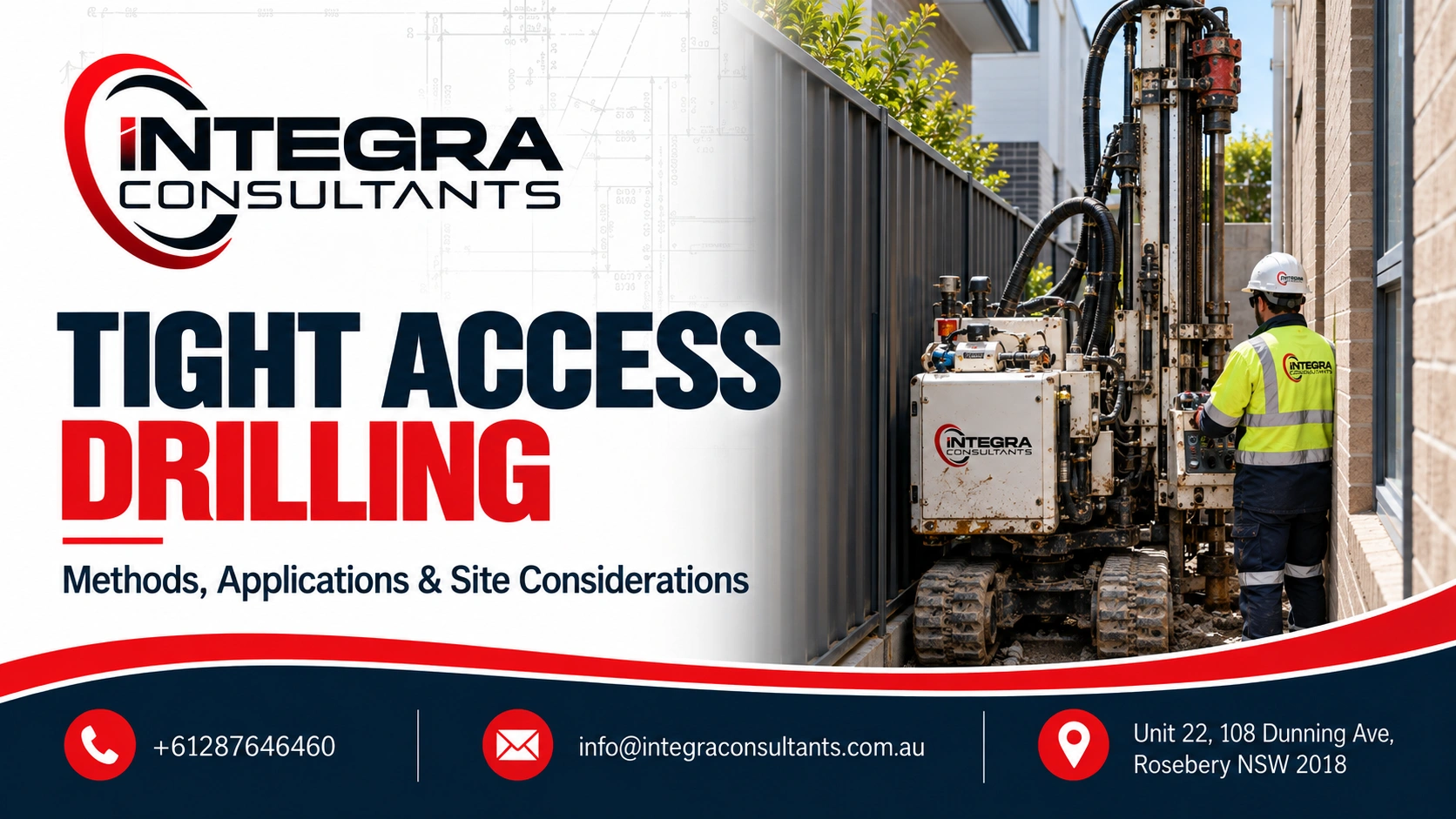
A Practical Guide to Restricted Access Drilling for Residential, Commercial and Civil Construction Projects
Construction projects often require detailed information about the soil, rock and groundwater beneath a site before design and construction begin. A geotechnical investigation provides this information, helping engineers assess foundation requirements, excavation conditions and potential ground-related risks.
However, not every property can accommodate conventional drilling equipment. Narrow driveways, small backyards, steep terrain, existing buildings and limited working areas can make subsurface investigations more challenging.
This is where tight access drilling becomes important.
Tight access drilling involves using specialised, compact or modular drilling equipment to investigate ground conditions in locations where conventional drilling rigs may not fit or operate effectively. Depending on the site and investigation requirements, these systems can help collect soil and rock samples, establish subsurface profiles and obtain information for geotechnical assessment.
For residential, commercial and civil construction projects across Sydney and NSW, restricted access drilling can help overcome physical site limitations while obtaining the ground information needed for informed engineering decisions.
Integra Consultants provides geotechnical engineering and investigation services to support property owners, builders and developers with site-specific ground assessments and construction planning.
What Is Tight Access Drilling?
Tight access drilling is a specialised approach to drilling investigations where physical access, working space, clearance or terrain limits the use of conventional drilling equipment.
Standard drilling rigs may require adequate entry widths, vehicle access, sufficient headroom and a stable working platform. These requirements can be difficult to meet on established residential properties, narrow urban blocks and sites surrounded by existing structures.
Depending on the investigation objectives, tight access drilling may use compact track-mounted rigs, modular drilling systems or portable equipment designed for restricted locations.
Potential applications include:
- Narrow residential properties and side access areas
- Small backyards and confined work zones
- Sites between existing buildings
- Sloping blocks and difficult terrain
- Basement and excavation projects
- Locations with limited vehicle access
The purpose remains the same as conventional geotechnical drilling: to obtain reliable information about subsurface conditions. The appropriate equipment and drilling method depend on the required investigation depth, ground conditions, available clearance and project objectives.
Why Is Tight Access Drilling Needed?
Construction increasingly takes place in established urban areas where available space is limited. Existing houses, garages, retaining walls, fences, landscaping and underground services can restrict the movement and positioning of drilling equipment.
In some situations, conventional drilling rigs cannot reach the required investigation point without significant access preparation.
Tight access drilling may provide a suitable alternative for projects involving:
- Residential extensions and renovations
- New homes on restricted blocks
- Basement developments
- Foundation investigations
- Retaining wall construction
- Slope stability assessments
- Small commercial developments
- Selected environmental and groundwater investigations
The method can reduce the need for extensive access modifications where suitable equipment is available. However, feasibility must be assessed for each site, particularly when drilling depth, hard rock, overhead clearance or difficult ground conditions create additional constraints.
Obtaining appropriate ground information before construction helps reduce uncertainty and supports more informed engineering decisions.
Common Challenges of Restricted Access Sites
Restricted access investigations require more than simply bringing a smaller drilling rig to the property. The entire work area must be assessed to determine whether the proposed investigation can be completed safely and effectively.
1. Limited Working Space
Small residential blocks and narrow side passages may not provide enough room for conventional drilling equipment, stabilisation, sample handling or other field activities.
Compact equipment may be suitable for these locations, provided there is sufficient clearance and working space for safe operation.
2. Difficult Site Entry
Access may be restricted by narrow gates, steps, uneven pathways, steep driveways or changes in ground level.
The dimensions and weight of the equipment, transport arrangements and the route to the drilling location all influence equipment selection.
3. Existing Structures and Property Boundaries
Drilling locations may be close to houses, garages, boundary walls, retaining structures and neighbouring properties.
Investigation planning should consider equipment positioning, ground disturbance, potential vibration and the need to protect surrounding structures.
4. Underground and Overhead Services
Water pipes, gas lines, electrical cables, communication infrastructure and overhead obstructions can affect drilling access and safety.
Relevant service information, site checks and appropriate service-location procedures should be completed before ground penetration begins.
5. Variable Ground Conditions
Restricted access does not necessarily mean simple geology. A site may contain uncontrolled fill, hard rock, weak soil layers or groundwater that complicates drilling.
The selected method must be capable of addressing the expected ground conditions and collecting information suitable for the engineering assessment.
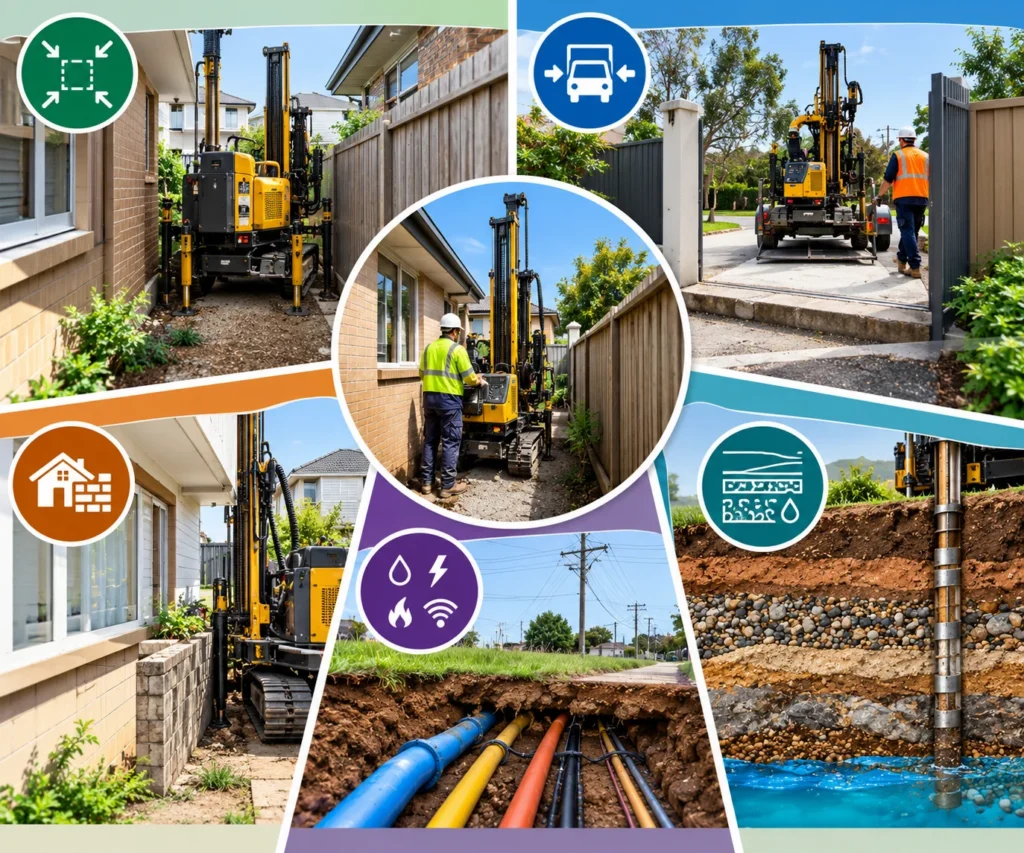
Tight Access Drilling Methods
Different drilling systems are available for restricted locations. The appropriate method depends on the site layout, investigation depth, required samples, geology and project specifications.
1. Portable Drilling Equipment
Portable drilling systems are designed for locations where transporting a conventional drilling rig is impractical.
Some systems can be moved in components through narrow access routes and assembled near the investigation location.
Potential applications include residential site investigations, shallow ground assessments and locations with limited equipment access.
The achievable drilling depth and sampling capability vary by equipment type and ground conditions.
2. Track-Mounted Mini Drilling Rigs
Mini drilling rigs mounted on tracks can provide mobility in areas where access is restricted and the ground surface is suitable for the equipment.
Their compact configuration may make them useful for residential sites, confined work areas and selected sloping locations.
However, tracked equipment still requires an appropriate access route and suitable ground conditions. Steep slopes, soft surfaces and restricted overhead clearance may require additional assessment or a different drilling arrangement.
3. Modular Drilling Systems
Modular drilling systems can be transported in separate components and assembled within a restricted work area.
This configuration may help overcome narrow entrances or situations where a complete drilling rig cannot reach the investigation point.
The practical suitability depends on assembly space, handling requirements, site safety and the drilling system’s technical capabilities.
4. Hand-Carried or Manually Operated Equipment
Some investigations may be completed using lightweight, manually operated equipment where access is extremely limited.
These systems can be useful for selected shallow investigations or preliminary assessments, depending on the project requirements.
They should not be treated as a direct substitute for every borehole investigation. The achievable depth, sampling quality and type of ground information may differ from those obtained using specialised drilling rigs.
5. Specialist Drilling Techniques
Depending on the geology and investigation objectives, a restricted access project may require a particular drilling technique rather than equipment size alone.
The drilling method must be selected according to factors such as soil and rock conditions, required investigation depth, sample quality, groundwater considerations and the purpose of the assessment.
A geotechnical consultant can determine the appropriate investigation approach based on the available site information and project requirements.
Applications of Tight Access Drilling
Tight access drilling supports different types of construction and engineering projects where conventional drilling access is limited.
1. Residential Construction and Extensions
Established residential properties often have narrow side passages, small backyards, existing landscaping and boundary restrictions.
Tight access drilling may help investigate ground conditions for:
- New residential construction
- Home extensions
- Renovation projects
- Swimming pool developments
- Replacement or additional foundations
- Small residential developments
The resulting information can help engineers assess soil conditions and establish suitable foundation design parameters.
2. Foundation Investigations
Foundation design requires an understanding of the material supporting the proposed structure.
Restricted access drilling may allow investigation points to be reached near existing buildings or within confined areas where ground information is needed.
Depending on the investigation scope, the results may help establish soil layers, rock depth, groundwater observations and relevant geotechnical design parameters.
These findings support foundation assessments but must be considered alongside structural loads, settlement requirements and the proposed building design.
3. Retaining Wall Projects
Retaining walls must resist lateral soil pressure and account for relevant groundwater, drainage and stability conditions.
Restricted access drilling may be useful where investigation points are located behind existing walls, along narrow boundaries or on properties with limited working space.
Ground information can help engineers assess subsurface conditions and develop appropriate recommendations for retaining wall design and construction.
4. Sloping Sites and Slope Stability Assessments
Sloping properties can present additional challenges involving erosion, drainage, ground movement and slope stability.
Conventional drilling equipment may be difficult to position where access is narrow or the terrain is uneven.
Suitable tight access equipment may allow investigation of soil layers, rock conditions and other subsurface characteristics needed for a geotechnical assessment.
The results can help engineers determine whether additional stability analysis, drainage measures or ground support may be necessary.
5. Basement Construction and Excavation
Basement developments often require detailed ground investigations because excavation can affect surrounding soil, groundwater and nearby structures.
Urban properties may provide limited space between the proposed basement, existing buildings and property boundaries.
Tight access drilling can help obtain ground information from suitable investigation locations where conventional rigs cannot easily operate.
The investigation may inform excavation planning, foundation design, groundwater management and the assessment of potential effects on neighbouring structures.
6. Commercial and Urban Redevelopment
Commercial sites and urban redevelopment projects may involve existing buildings, narrow access routes or constrained work zones.
Restricted access drilling may be suitable for selected investigations where ground information is required without bringing large equipment onto the property.
The feasibility of the method depends on the required drilling depth, investigation coverage, site constraints and the project’s geotechnical objectives.
7. Environmental and Groundwater Investigations
Selected environmental investigations may require access to soil or groundwater at locations that are difficult to reach with conventional drilling equipment.
Depending on the project, specialist drilling systems may support soil sampling, groundwater monitoring installations or site assessment activities.
Environmental investigations require appropriate sampling procedures, contamination controls and equipment selection. The method must be suitable for the specific environmental objectives and regulatory requirements.
Benefits of Tight Access Drilling
Tight access drilling can offer practical advantages where conventional equipment cannot reach the required investigation location.
1. Access to Confined Locations
Compact or modular drilling systems may reach areas that are inaccessible to larger rigs.
This can help investigate narrow residential blocks, restricted backyards and selected urban construction sites.
2. Reduced Access Modifications
Where suitable equipment is available, a project may avoid some of the extensive access preparation that a larger rig would require.
This can be particularly useful when existing structures, landscaping or boundary conditions limit equipment movement.
The extent of any reduction depends on the site layout and the equipment selected.
3. Site-Specific Ground Information
Restricted access drilling can provide valuable subsurface information when the method is appropriately matched to the investigation requirements.
The resulting data may help engineers understand soil profiles, rock conditions and other relevant ground characteristics.
The quality and extent of the information depend on the drilling method, sampling procedures and investigation scope.
4. Better-Informed Construction Planning
Identifying ground conditions before construction can help project teams evaluate foundation options, excavation requirements and potential geotechnical risks.
This information may support more informed decisions about design, budgeting and construction sequencing.
5. Flexibility for Urban Projects
Compact drilling systems can provide additional options for projects in developed areas where space is limited.
This flexibility can be valuable for renovations, extensions, retaining walls and selected redevelopment projects.
Factors to Consider Before Tight Access Drilling
A successful investigation begins with a site-specific assessment. Several factors determine whether tight access drilling is feasible and which equipment should be used.
1. Site Access and Clearance
The consultant or drilling provider should assess:
- Entrance and pathway widths
- Available headroom
- Turning and manoeuvring space
- Ground surface condition
- Equipment transport and assembly requirements
- Access to the proposed drilling location
These factors help determine whether the equipment can reach and operate at the required location.
2. Required Drilling Depth
Different drilling systems have different depth capabilities.
A shallow residential investigation may require a different approach from a project involving deep foundations, a basement or a complex subsurface profile.
The proposed method must be capable of obtaining sufficient information for the intended engineering assessment.
3. Soil, Rock and Groundwater Conditions
Ground conditions influence drilling performance, sampling and equipment requirements.
Hard rock, loose soil, uncontrolled fill and groundwater may create additional challenges. Available geological information and the investigation objectives should inform the drilling plan.
4. Underground Services
Underground infrastructure must be considered before drilling.
Service-location procedures should follow applicable requirements and site conditions. The proposed drilling locations may need to be adjusted where services or other obstructions are identified.
5. Nearby Buildings and Structures
Existing houses, boundary walls, retaining walls and neighbouring buildings may influence drilling positions and operating arrangements.
Where relevant, the investigation plan should consider ground disturbance, vibration and the protection of adjacent structures.
6. Site Safety and Working Conditions
Equipment operation, worker access, terrain, overhead obstructions and ground stability all affect the safe execution of drilling activities.
The work area should be assessed and appropriate controls established before drilling begins.
7. Investigation Scope and Budget
The total cost depends on more than the size of the drilling rig.
Factors may include mobilisation, restricted access, drilling depth, ground conditions, sampling, laboratory testing and reporting requirements.
A suitable proposal should reflect the investigation objectives and the level of information needed for the project.
Tight Access Drilling vs Standard Drilling
Both methods are used to obtain subsurface information. Their main differences relate to equipment configuration, access requirements and operational constraints.
| Consideration | Standard Drilling | Tight Access Drilling |
| Equipment | Often uses larger drilling rigs | Uses compact, modular or specialised equipment |
| Site access | Requires access suitable for the rig | Designed to address restricted access conditions |
| Working area | Generally needs more space | May operate in smaller work areas |
| Transport | May require vehicle access to the drilling location | Some systems can be transported in components |
| Investigation capability | Depends on the rig and drilling method | Depends on the compact system and selected method |
| Site preparation | May require additional access preparation | May reduce some access modifications |
| Cost | Depends on scope and site conditions | May involve additional mobilisation or specialised equipment costs |
Neither approach is automatically better or cheaper. The appropriate method depends on the investigation objectives, site constraints, ground conditions and equipment capabilities.
How Geotechnical Consultants Plan Restricted Access Investigations
A restricted access investigation requires coordination between the investigation objectives, equipment selection and site conditions.
Step 1: Review the Project Requirements
The consultant reviews the proposed development, available drawings, investigation objectives and relevant design requirements.
This establishes the type of ground information needed for the project.
Step 2: Assess the Site
The access route, available clearance, working space, terrain, existing structures and potential underground services are considered.
A site inspection may be required when photographs, drawings or other available information are insufficient to establish feasibility.
Step 3: Select the Drilling Method
The drilling system is selected according to access restrictions, expected ground conditions, required depth and sampling needs.
The selected method must be capable of producing information suitable for the geotechnical assessment.
Step 4: Conduct the Investigation
Drilling is undertaken at the planned locations using the selected method and appropriate field procedures.
Depending on the investigation scope, activities may include logging soil and rock layers, collecting samples, conducting field tests and recording groundwater observations.
Step 5: Analyse the Findings
The investigation results are reviewed alongside the project requirements and available geological information.
Laboratory testing or further investigation may be necessary where additional data is required.
Step 6: Prepare the Geotechnical Report
The findings are documented in a report appropriate to the investigation scope.
Recommendations may address foundation design parameters, excavation conditions, ground stability, groundwater considerations and other relevant construction requirements.
Choosing a Tight Access Drilling Provider
Selecting a suitable drilling provider is important because restricted access projects can require specialised equipment, careful logistics and coordination with geotechnical engineers.
Experience With Restricted Sites
Look for experience with properties that have narrow access, existing structures, difficult terrain or limited working space.
Experience with similar projects can help identify practical equipment and site preparation requirements.
Appropriate Equipment
The provider should be able to identify equipment suited to the available clearance, required depth and expected ground conditions.
Compact equipment alone is not sufficient if it cannot meet the investigation objectives.
Geotechnical Engineering Coordination
Drilling results need to be interpreted in the context of the proposed development.
Coordination between the drilling provider and the geotechnical consultant helps ensure the investigation produces useful information for engineering decisions.
Safety and Quality Procedures
Confirm that the proposed work accounts for underground services, equipment operation, site constraints, sample handling and relevant safety requirements.
Clear Scope and Reporting
Before work begins, clarify the proposed investigation locations, drilling depths, testing requirements, deliverables and any limitations.
A clear scope helps align the field investigation with the information required for design and construction.
Frequently Asked Questions About Tight Access Drilling
What is tight access drilling?
Tight access drilling is a specialised approach to subsurface investigation that uses suitable equipment to operate where conventional drilling rigs may not fit or work effectively. It can provide ground information for construction and geotechnical assessments.
Where is tight access drilling used?
It may be used on residential properties, narrow urban blocks, sloping sites, basement projects, retaining wall developments and selected commercial or environmental investigation sites where access is restricted.
Is tight access drilling more expensive than standard drilling?
Costs depend on access conditions, mobilisation, equipment requirements, drilling depth, ground conditions, testing and reporting. Specialised equipment may increase some costs, while reduced access preparation may offset others in certain situations.
Can tight access drilling be used on residential properties?
Yes. Suitable compact or modular systems may be used for residential investigations where narrow driveways, small backyards, existing buildings or limited working space prevent conventional rig access.
How deep can tight access drilling go?
There is no single depth applicable to every tight access drilling system. The achievable depth depends on the equipment, drilling method, ground conditions, access limitations and investigation requirements.
Does tight access drilling provide accurate geotechnical information?
It can provide useful and reliable information when the drilling method, sampling procedures and investigation scope are appropriate for the project. The limitations of the selected equipment and method should be considered when interpreting the results.
Is tight access drilling suitable for sloping sites?
Some compact drilling systems may be suitable for selected sloping sites. Feasibility depends on the slope, ground stability, equipment capabilities, access arrangements and safe working requirements.
What information is needed before arranging tight access drilling?
Useful information includes the property address, site photographs, access width and headroom, available plans, proposed development, required investigation depth and any known underground services. A site assessment may be necessary before confirming the method.
Conclusion: Finding the Right Drilling Solution for Restricted Sites
Obtaining reliable information about ground conditions is an important part of construction planning. However, narrow access routes, existing structures, steep terrain and limited working space can make conventional drilling difficult.
Tight access drilling provides an alternative for suitable sites by using compact, modular or specialised equipment to investigate ground conditions in restricted locations.
From residential extensions and foundation assessments to retaining walls, basement construction and selected environmental investigations, the right drilling approach can help engineers obtain the information needed to assess ground conditions and support informed design decisions.
Successful outcomes depend on selecting an appropriate method, assessing site access, identifying potential hazards and ensuring that the investigation meets the project’s technical requirements.
Integra Consultants provides geotechnical investigation and engineering services across Sydney and NSW. If your property has restricted access or challenging site conditions, the team can help assess the investigation requirements and determine a suitable approach.
Contact Integra Consultants to discuss your geotechnical investigation requirements.
- Address: Unit 22, 108 Dunning Avenue, Rosebery NSW 2018
- Phone: +61 2 8764 6460
- Email: info@integraconsultants.com.au
- Website: https://integraconsultants.com.au/