Selecting the right pavement materials is a fundamental part of successful pavement design. Material choices directly influence structural performance, durability, constructability, maintenance requirements, and whole-of-life cost.
The pavement material selection Australia framework draws heavily on Austroads guidance together with state road authority specifications and project-specific requirements. Engineers must consider much more than initial material cost. Traffic loading, subgrade conditions, climate, moisture exposure, material availability, construction methods, sustainability objectives, and long-term performance all influence the final selection.
This guide explores the key criteria used to select Australian pavement construction materials and explains how granular materials, stabilised materials, asphalt, concrete, and recycled alternatives can be matched to specific pavement applications.
What Is the Austroads Guide to Pavement Technology Part 4?
The Austroads Guide to Pavement Technology Part 4 series provides guidance relating to materials used in road pavement construction across Australia and New Zealand.
Rather than treating all pavement materials as a single category, the Austroads framework includes dedicated guidance for different material types.
These include areas such as:
- Granular base and subbase materials
- Asphalt
- Concrete pavement materials
- Stabilised materials
- Binders
- Aggregates
- Sprayed seals
- Other pavement material applications
This structure allows pavement designers to consider both general material-selection principles and detailed technical requirements applicable to individual pavement materials.
Material selection should also be considered alongside pavement structural design because the engineering properties of each layer directly influence how the pavement responds to traffic loads.
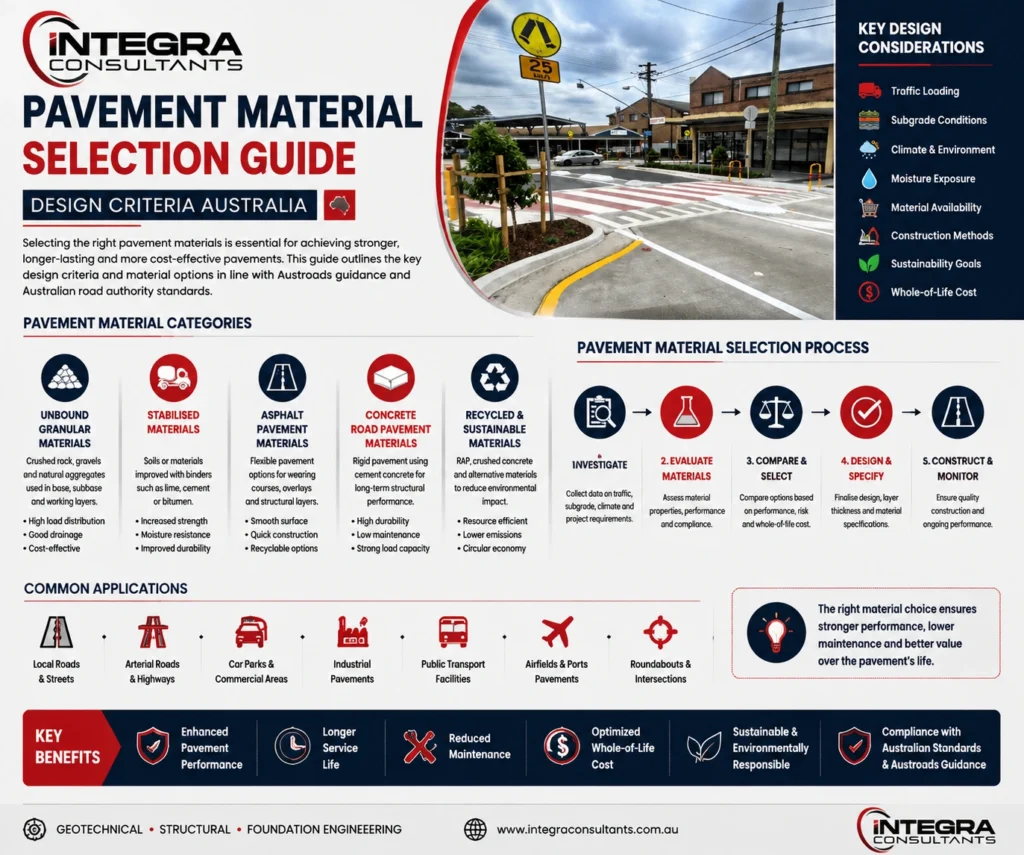
What Are the Key Pavement Material Categories in Australia?
Understanding the main categories of Australian pavement construction materials is essential before selecting a pavement structure.
Different materials respond differently to traffic loading, environmental conditions, moisture, temperature, and subgrade movement.
Unbound Granular Materials
Unbound granular pavement materials generally consist of crushed rock, processed aggregates, natural gravels, or blends designed to satisfy specified grading and engineering requirements.
They are commonly used in:
- Pavement base layers
- Subbase layers
- Working platforms
- Local roads
- Access roads
- Car parks
- Flexible pavement systems
Their structural performance depends on factors such as:
- Particle size distribution
- Aggregate strength
- Plasticity
- Moisture content
- Compaction
- Particle interlock
- Drainage
- Subgrade support
Good-quality granular materials distribute wheel loads through aggregate interlock and friction between particles.
Material specifications are particularly important because two aggregates that look similar can behave very differently under repeated traffic loading.
Stabilised Pavement Materials
Stabilised materials are created by modifying an existing soil or pavement material using a binder or another treatment process.
Potential binders include:
- Lime
- Cement
- Blended cementitious binders
- Foamed bitumen
- Other approved stabilising agents
Stabilisation can be used to improve:
- Strength
- Stiffness
- Workability
- Moisture resistance
- Bearing capacity
- Durability
- Construction performance
Stabilised pavement materials can be particularly useful where existing materials do not provide sufficient engineering performance in their untreated condition.
They may also reduce the need to excavate and replace large quantities of existing material.
However, stabilisation must be carefully designed.
Excessive binder content can create an overly stiff or brittle layer, while inadequate treatment may fail to achieve the required engineering performance.
Laboratory testing and project-specific mix design are therefore important.
Asphalt Pavement Materials
Asphalt pavement materials used in Australia include a wide range of mix types designed for different traffic, structural, and surfacing requirements.
Asphalt may be used as:
- Wearing course
- Intermediate layer
- Structural asphalt
- Full-depth asphalt
- Heavy-duty pavement surfacing
- Rehabilitation overlay
Material selection depends on factors including:
- Traffic loading
- Pavement temperature
- Rutting resistance
- Fatigue resistance
- Moisture sensitivity
- Surface texture
- Skid resistance
- Layer thickness
- Construction conditions
Modern asphalt technology also allows designers to consider modified binders, reclaimed asphalt pavement, crumb rubber, and other performance-enhancing or recycled materials where appropriate.
Concrete Road Pavement Materials
Concrete is commonly selected where high stiffness, durability, and resistance to heavy or concentrated loading are important.
Concrete pavements may be used for:
- Highways
- Industrial hardstands
- Freight facilities
- Bus facilities
- Loading areas
- Heavy vehicle parking
- Ports
- Warehouses
- Distribution centres
Concrete pavement performance depends on more than compressive strength.
Designers also need to consider:
- Flexural strength
- Aggregate properties
- Cementitious materials
- Shrinkage
- Durability
- Joint design
- Load transfer
- Reinforcement
- Subbase support
- Curing
- Environmental exposure
Aggregate quality is especially important because it can influence concrete strength, durability, shrinkage, skid resistance, and long-term performance.
What Criteria Drive Pavement Material Selection?
There is no single pavement material that is best for every project.
The correct pavement material selection depends on several interrelated engineering, environmental, construction, and economic factors.
Strength Requirements
Pavement materials must be capable of supporting the expected traffic loads without excessive deformation or structural deterioration.
Different pavement layers perform different structural functions.
For example:
- Granular layers distribute loads
- Asphalt provides flexibility and structural capacity
- Stabilised materials can increase stiffness
- Concrete distributes concentrated loads through slab action
The required material strength therefore depends on its position within the pavement structure and the loads it is expected to carry.
Industrial and heavy-duty pavements may require particularly high-performance materials because forklifts, reach stackers, trucks, or specialised equipment can create concentrated loads.
Durability and Stability
Material selection should consider how pavement materials will behave throughout the design life rather than only at the time of construction.
Important durability considerations include:
- Weathering resistance
- Moisture susceptibility
- Repeated traffic loading
- Temperature effects
- Chemical exposure
- Aggregate breakdown
- Binder ageing
- Shrinkage
- Swelling
- Erosion
Volume stability is also important.
Materials that experience excessive expansion, shrinkage, or moisture-related movement may contribute to cracking or deformation of the pavement structure.
Moisture Resistance and Drainage
Water is one of the most significant influences on pavement performance.
Materials that perform well under dry laboratory conditions may behave very differently when saturated.
Material selection therefore needs to consider:
- Permeability
- Drainage
- Groundwater
- Capillary moisture
- Surface infiltration
- Moisture sensitivity
- Seasonal moisture variation
Where drainage conditions are difficult, engineers may select materials with improved moisture resistance or introduce drainage and separation layers to protect the pavement structure.
Traffic Loading
Traffic loading strongly influences material selection.
A lightly trafficked residential access road has very different material requirements from:
- A freight route
- An industrial hardstand
- A logistics facility
- A bus depot
- A container terminal
- A heavily trafficked arterial road
Increasing axle loading and traffic repetitions may require stronger granular materials, structural asphalt, stabilised layers, concrete, or a combination of these materials.
Construction Requirements
A theoretically strong pavement material may still be unsuitable if it cannot be practically constructed under site conditions.
Constructability considerations include:
- Site access
- Available construction equipment
- Weather
- Required construction speed
- Compaction requirements
- Material delivery distance
- Working space
- Traffic staging
- Curing requirements
- Quality-control capability
Material selection should therefore consider both engineering performance and practical delivery.
How Does Subgrade Assessment Influence Pavement Material Selection?
The subgrade provides support to all pavement layers above it.
Weak, moisture-sensitive, compressible, or highly variable subgrades generally require different pavement materials and treatment strategies from strong, stable ground.
For weak subgrades, engineers may consider:
- Higher-quality granular base materials
- Granular capping
- Stabilised subgrade
- Stabilised subbase
- Geogrids
- Geotextiles
- Improved drainage
- Removal and replacement
- Increased pavement thickness
The interaction between pavement layers and the supporting ground is also important when conditions are complex.
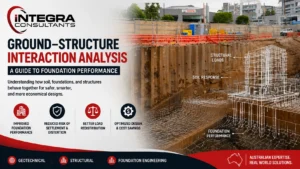
For projects where deformation, settlement, non-standard loading, or complex soil behaviour needs to be assessed in greater detail, ground–structure interaction analysis can help engineers understand how ground conditions and structural loading interact and support more informed engineering decisions.
Material selection should therefore never be undertaken independently of geotechnical assessment.
A premium pavement material cannot necessarily compensate for an inadequately investigated or poorly prepared subgrade.
How Should Granular Pavement Materials Be Selected?
Granular materials are widely used across Australian pavement projects.
However, material quality can vary significantly depending on the source and processing method.
Important selection properties can include:
- Particle size distribution
- Plasticity index
- Liquid limit
- California Bearing Ratio
- Aggregate crushing resistance
- Durability
- Shape
- Flakiness
- Compaction characteristics
- Moisture sensitivity
Designers should also confirm that the nominated material satisfies the requirements of the relevant road authority, council, or project specification.
For example, Transport for NSW maintains an official Register of Materials, including information relevant to granular materials used for surfaced road pavement base and subbase applications.
Using project-approved and specification-compliant materials helps reduce the risk of construction delays and unexpected pavement performance problems.
How Are Asphalt Pavement Materials Selected?
Selecting an asphalt mix involves balancing several performance requirements.
Rutting Resistance
Heavy and slow-moving traffic can cause permanent deformation in asphalt.
Industrial areas, intersections, bus lanes, loading zones, and freight routes may therefore require mixes with improved resistance to rutting.
Fatigue Resistance
Repeated wheel loading produces tensile and shear strains within asphalt layers.
The selected asphalt needs to provide appropriate resistance to fatigue deterioration throughout the design life.
Temperature Performance
Australian pavements can experience high surface temperatures.
Asphalt binder and mix selection should therefore consider local climatic conditions and the risk of temperature-related deformation or ageing.
Moisture Resistance
Asphalt must resist deterioration caused by the interaction of water and aggregate-binder interfaces.
Drainage and mix design both influence this performance.
Surface Requirements
For wearing courses, designers may also need to consider:
- Skid resistance
- Surface texture
- Noise
- Spray
- Ride quality
- Waterproofing
- Durability
The best structural asphalt is not automatically the best wearing-course material, which is why different asphalt layers may use different mixes.
How Are Concrete Pavement Materials Selected?
Concrete pavement materials require careful coordination between structural design, material specification, and construction practice.
Important criteria include:
- Concrete strength
- Flexural capacity
- Aggregate quality
- Cementitious binder
- Shrinkage
- Workability
- Durability
- Abrasion resistance
- Environmental exposure
- Curing requirements
Concrete used for heavy-duty pavement applications may need to resist concentrated wheel loads and repeated loading near joints and slab edges.
Joint detailing, slab thickness, load transfer, and foundation support can be just as important as the concrete mix itself.
Concrete material selection should therefore form part of the complete pavement system rather than being considered as an isolated specification.
How Are Quality and Performance Ensured?
Selecting the right material is only the first step.
The pavement will not perform as designed unless the supplied and constructed materials meet the required specification.
Quality assurance may include:
- Source approval
- Material sampling
- Laboratory testing
- Grading tests
- Plasticity testing
- Moisture testing
- Compaction testing
- Density testing
- Strength testing
- Asphalt production testing
- Concrete testing
- Layer thickness verification
Construction quality is particularly important for granular and stabilised materials because their performance can be highly dependent on moisture content and compaction.
Even high-quality material can perform poorly if it is placed incorrectly.
What Role Does Sustainability Play in Pavement Material Selection?
Sustainability is becoming increasingly important in Australian pavement engineering.
Material selection can influence:
- Virgin resource consumption
- Transport distances
- Energy use
- Carbon emissions
- Waste generation
- Recycling
- Future rehabilitation requirements
Potential sustainable pavement materials include:
- Reclaimed asphalt pavement
- Recycled aggregates
- Crumb-rubber-modified asphalt
- Recycled glass in suitable applications
- Recovered construction materials
- Supplementary cementitious materials
- In-situ recycled pavement materials
However, recycled content should not be selected solely because it is recycled.
The material still needs to satisfy appropriate engineering and performance requirements.
The objective should be to achieve both environmental benefit and acceptable long-term pavement performance.
What Are the Latest Innovations in Pavement Materials?
Pavement material technology continues to develop as road agencies, researchers, contractors, and material suppliers seek better performance and more sustainable construction methods.
Crumb Rubber Asphalt
Crumb rubber derived from end-of-life tyres can be incorporated into certain asphalt and sprayed-seal applications.
Potential advantages may include improved flexibility and cracking resistance when the material is appropriately designed and constructed.
Its suitability depends on the specific pavement application, traffic environment, climate, binder system, and relevant specification requirements.
EME2 High Modulus Asphalt
EME2 is a high-modulus asphalt material intended for structural pavement applications.
Its relatively high stiffness can make it useful for heavily trafficked pavement structures where designers need significant structural capacity within a controlled pavement thickness.
As with any specialist asphalt material, its use should be supported by appropriate pavement analysis and project specifications.
Reclaimed Asphalt Pavement
Reclaimed Asphalt Pavement, commonly known as RAP, allows material recovered from existing asphalt pavements to be incorporated into new asphalt production where permitted.
Potential advantages include:
- Reduced demand for virgin aggregates
- Reduced demand for new bitumen
- Reduced waste
- Improved circularity of pavement materials
The allowable proportion and processing requirements depend on the asphalt mix, performance requirements, and applicable specifications.
In-Situ Pavement Recycling
Existing pavement materials can sometimes be processed, treated, and reused on site.
Potential benefits include:
- Reduced excavation
- Reduced imported material
- Fewer truck movements
- Reduced disposal
- Shorter construction programs
However, existing material must first be investigated to confirm that it is suitable for reuse.
Performance-Based Material Selection
Traditional specifications often focus heavily on material composition and prescriptive properties.
Modern pavement engineering increasingly considers performance-related testing alongside conventional material requirements.
This can help engineers assess properties directly related to expected field performance, particularly for advanced asphalt and stabilised pavement materials.
How Should Cost Be Considered When Selecting Pavement Materials?
Material selection should not be based solely on the lowest supply price.
A more complete assessment considers whole-of-life cost.
Relevant cost factors include:
- Material purchase
- Transport
- Construction
- Plant requirements
- Testing
- Maintenance
- Rehabilitation
- Traffic management
- Operational disruption
- Disposal
- Replacement
- Salvage or recycling value
For example, a more expensive pavement material may deliver better whole-of-life value if it significantly increases pavement life or reduces maintenance requirements.
Conversely, using a premium material where the traffic and site conditions do not require it may represent unnecessary expenditure.
The objective is to achieve the required pavement performance at an appropriate whole-of-life cost.
How Can Engineers Make Better Pavement Material Selection Decisions?
A systematic process can improve material-selection outcomes.
Understand the Subgrade
Complete appropriate geotechnical investigation before finalising pavement materials.
Confirm Traffic Loading
Material requirements should reflect the actual heavy vehicle demand and design life.
Review Environmental Conditions
Consider groundwater, rainfall, temperature, drainage, flooding, and moisture variation.
Identify Available Materials
Locally available compliant materials can significantly influence construction cost and practicality.
Compare Pavement Alternatives
Consider different combinations of granular, asphalt, stabilised, and concrete materials rather than assuming one pavement type from the beginning.
Check Authority Requirements
Review Austroads guidance together with relevant state road authority, council, client, and project specifications.
Evaluate Whole-of-Life Performance
Compare maintenance, rehabilitation, operational disruption, and design life—not simply initial material prices.
Verify Materials During Construction
Testing and quality assurance should confirm that the actual supplied material matches the properties assumed during design.
Conclusion
Effective pavement material selection in Australia requires much more than choosing between asphalt, concrete, or crushed rock.
Each pavement material performs a specific function within the overall pavement system, and its suitability depends on traffic loading, subgrade strength, moisture conditions, climate, constructability, durability, authority requirements, sustainability objectives, and whole-of-life cost.
Unbound granular materials remain fundamental to many flexible pavement systems, while stabilised materials can provide improved performance where greater strength or moisture resistance is required. Asphalt offers a versatile range of structural and surfacing solutions, while concrete provides high stiffness and durability for demanding applications.
At the same time, recycled materials, reclaimed asphalt pavement, crumb rubber technologies, pavement recycling, and performance-based specifications are creating new opportunities for more sustainable and efficient pavement construction.
The most successful material-selection strategy is therefore not based on a single preferred product. It involves matching material properties to actual project conditions and verifying that those materials are correctly specified, constructed, and tested.
By combining sound pavement engineering, geotechnical assessment, traffic analysis, specification compliance, construction quality control, and whole-of-life evaluation, engineers can develop pavement structures that are durable, cost-effective, and appropriate for Australian conditions.