Understanding the ground before you design the structure
Before designing a building, basement, retaining wall, pavement or other infrastructure, there is a fundamental question that should be answered:
What is beneath the site, and how will the ground behave when you build on, excavate or load it?
The ground beneath a project is part of the engineering design.
A site may appear stable from the surface, yet subsurface conditions can vary significantly over relatively short distances. Fill, clay, sand, weathered rock, bedrock, groundwater, and other geological materials can influence foundation selection, settlement, excavation stability, shoring, dewatering, construction methodology and project cost.
This is why geotechnical investigation should be considered early in the design process, rather than treated as a late-stage requirement.
For projects in Sydney and across NSW, a properly planned investigation provides the evidence engineers need to understand the ground, identify potential risks and develop practical engineering solutions.
What is geotechnical investigation?
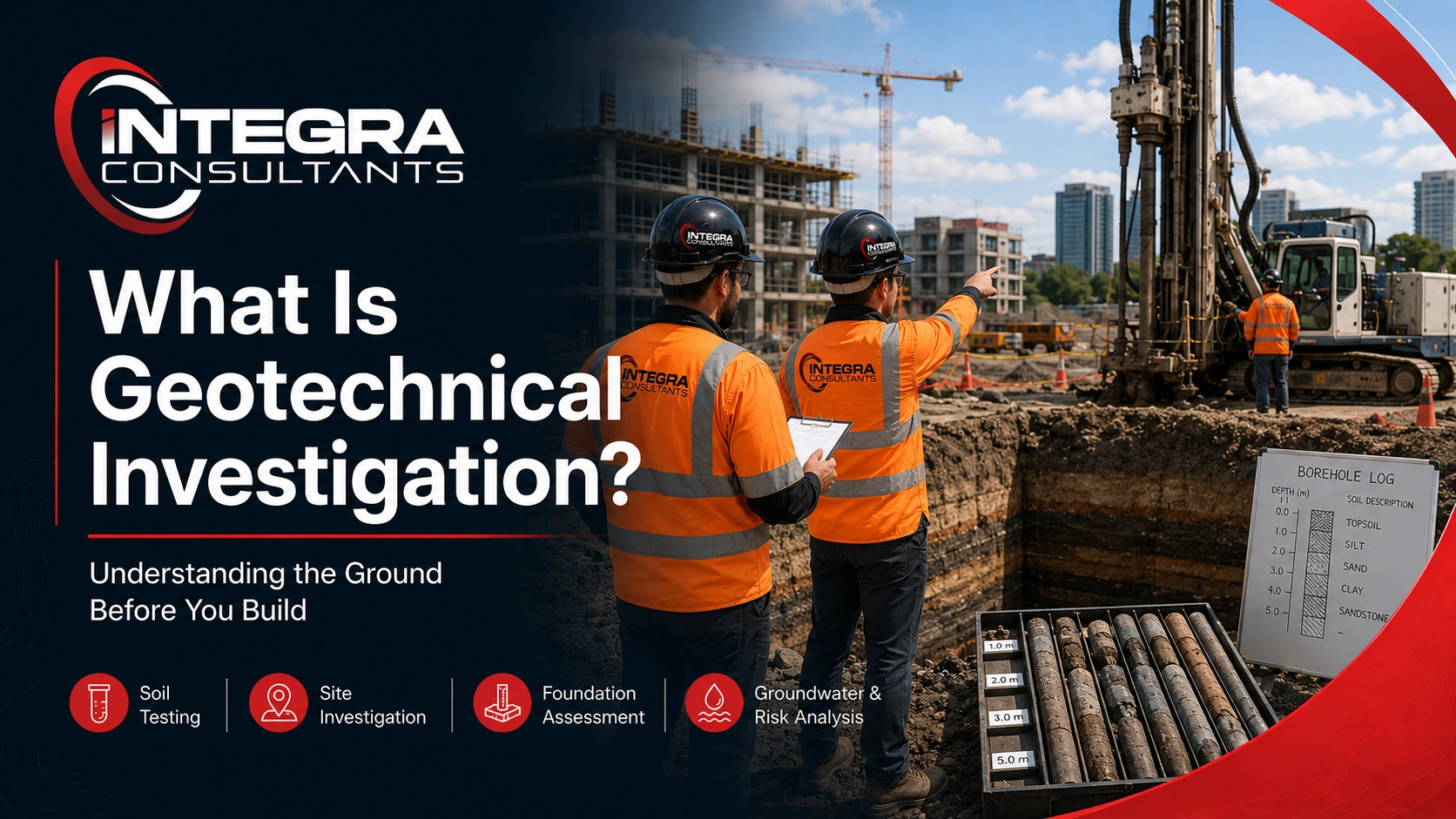
A geotechnical investigation is the systematic investigation and assessment of the soil, rock and groundwater conditions at a site to support engineering design and construction.
Under AS 1726:2017 Geotechnical site investigations, the investigation process is intended to establish information about the site’s geotechnical conditions and provide a standardised approach to identifying, describing and classifying soil and rock. The Standard applies to natural and filled ground for new construction, existing facilities, post-construction assessment, failure assessment and broader geotechnical studies. (Intertek Inform)
A project-specific investigation may include:
- Desktop review of geological and historical information
- Site inspection
- Boreholes
- Test pits
- Standard Penetration Testing (SPT)
- Dynamic Cone Penetrometer (DCP) testing
- Cone Penetration Testing (CPT)
- Soil and rock sampling
- Groundwater observations and monitoring
- Laboratory testing
- Soil classification and site assessment
- Bearing capacity and settlement assessment
- Excavation and slope stability assessment
- Foundation recommendations
- Construction recommendations
The scope should be fit for purpose.
A small residential development does not necessarily require the same investigation as a multi-level basement, high-rise building, bridge, retaining structure or major infrastructure project.
The objective is not to perform the maximum number of tests.
The objective is to obtain sufficient reliable information to make sound engineering decisions for the proposed development.
Why can’t you simply build based on what you can see?
Because the most important ground conditions are often below the surface.
Two neighbouring properties can have very different:
- Soil profiles
- Depths to competent material
- Groundwater conditions
- Fill conditions
- Rock levels
- Foundation conditions
- Settlement characteristics
For example, a site might contain:
0–0.5 m: uncontrolled fill
0.5–2.0 m: soft clay
2.0–5.0 m: stiff clay
5.0 m+: weathered rock
Another area of the same property could encounter competent rock at a much shallower depth.
That difference can affect the entire engineering solution.
It may influence whether the project requires shallow footings, a raft, piles, ground improvement, additional excavation, specialised shoring or groundwater management.
AS 1726:2017 recognises the importance of understanding the spatial and physical characteristics of soil, rock and groundwater when planning an effective investigation. (Intertek Inform)
The key principle is simple:
You cannot design the most appropriate foundation or excavation system until you understand the ground supporting or surrounding it.
Why is geotechnical investigation particularly important in Sydney?
Sydney is not a single, uniform ground environment.
The wider Sydney region is associated with the Sydney Basin, which contains a complex geological sequence including sedimentary rocks and younger deposits. (Bioregional Assessments)
Individual sites can also contain:
- Natural residual soils
- Sand and clay
- Weathered rock
- Sandstone
- Fill
- Alluvial deposits
- Groundwater
- Previously disturbed ground
- Buried structures or services
Urban development adds another layer of complexity.
A new building may need to be constructed:
- Beside an existing house
- Close to a property boundary
- Above or near underground services
- Adjacent to a road
- Near existing foundations
- Over previously filled land
- Close to Sydney Water infrastructure
- Above or beside a basement
As a result, the ground investigation needs to consider not only what is beneath the proposed building, but also how construction may affect the surrounding environment.
What does a geotechnical investigation tell you?
1. What type of soil and rock are present?
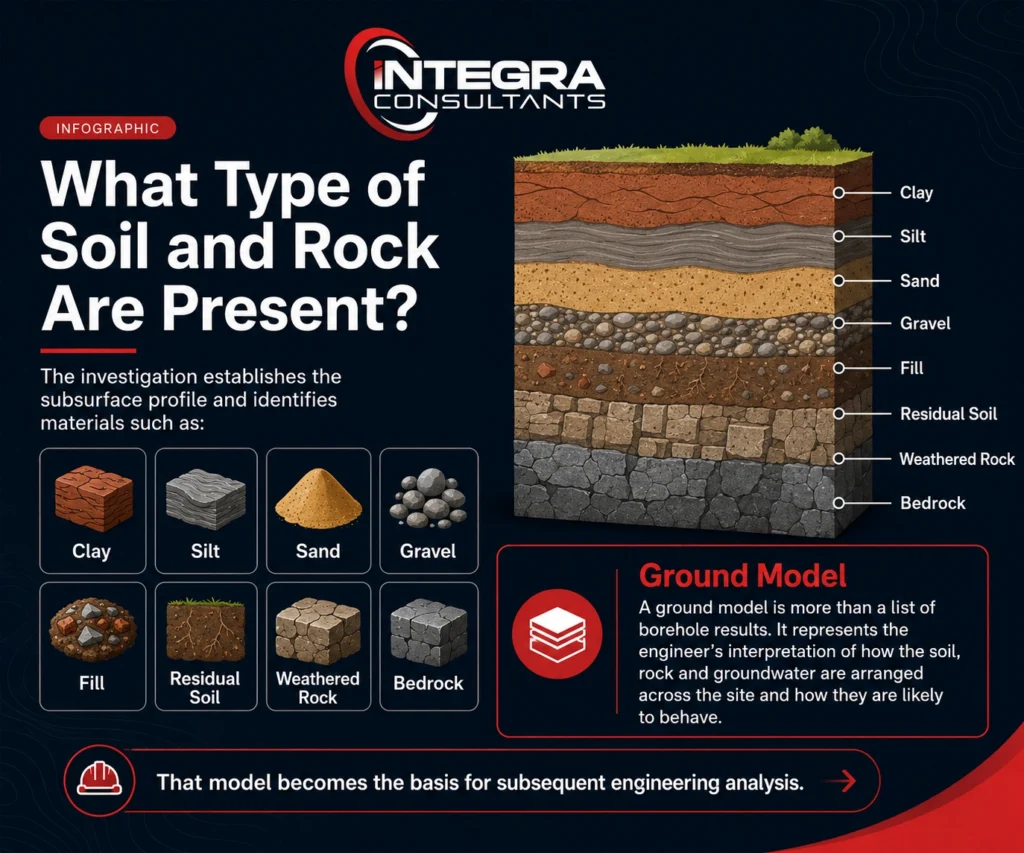
The investigation establishes the subsurface profile and identifies materials such as:
- Clay
- Silt
- Sand
- Gravel
- Fill
- Residual soil
- Weathered rock
- Bedrock
This information allows the engineer to develop a ground model.
A ground model is more than a list of borehole results. It represents the engineer’s interpretation of how the soil, rock and groundwater are arranged across the site and how they are likely to behave.
That model becomes the basis for subsequent engineering analysis.
2. How strong and stiff is the ground?
Buildings transfer loads into the ground through their foundations.
Engineers therefore need to understand how the ground will respond to those loads.
Investigation and testing can provide information relevant to:
- Soil strength
- Stiffness
- Density
- Bearing capacity
- Shear strength
- Compressibility
- Settlement
- Foundation performance
For example, competent material close to the surface may allow a shallow foundation system to be considered.
If weak or highly compressible material extends to significant depths, the engineer may need to consider a different foundation strategy.
Integra Consultants currently provides both shallow and deep foundation engineering as part of its broader civil and geotechnical capability. Its website also highlights complete site investigation and soil testing as a core service. (EngConf Solutions)
3. Is the site affected by reactive soil?
Some clay soils expand when they become wet and shrink as they dry.
Repeated changes in soil moisture can cause ground movement that affects:
- Footings
- Slabs
- Pavements
- Retaining structures
- Other elements of a building
For residential construction, AS 2870 Residential slabs and footings provides the framework for site classification based on expected ground movement.
Site conditions can range from relatively stable ground through to highly reactive or problem sites.
The important point is that the appropriate foundation solution should be based on the actual ground conditions rather than assumptions about the neighbourhood or property.
4. Is there uncontrolled fill?
Urban sites frequently contain fill.
But fill is not automatically equivalent to naturally deposited or engineered material.
Uncontrolled fill may have uncertain:
- Composition
- Density
- Strength
- Compressibility
- Moisture condition
- Settlement behaviour
This can create uncertainty for foundation design.
Depending on the site and proposed development, potential engineering solutions may include:
- Removal and replacement
- Controlled filling and compaction
- Foundation redesign
- Deep foundations
- Ground improvement
- Other engineered solutions
The correct solution depends on the actual site conditions and project requirements.
5. Where is groundwater?
Groundwater is one of the most important considerations for projects involving excavation.
It can influence:
- Excavation stability
- Effective soil strength
- Lateral earth pressures
- Basement design
- Retaining walls
- Shoring
- Piling
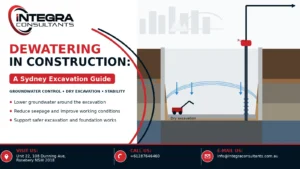
- Dewatering
- Ground movement
- Construction methodology
This is particularly important for deep basements and constrained Sydney sites.
Groundwater should therefore not be treated as a separate issue that is considered after the excavation design. Ground conditions, groundwater and excavation support need to be assessed together.
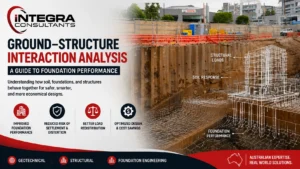
Integra’s current service offering includes deep excavation, shoring and dewatering, alongside ground-structure interaction analysis. (EngConf Solutions)
6. What type of foundation is appropriate?
One of the most important outputs of geotechnical engineering is information that supports the foundation strategy.
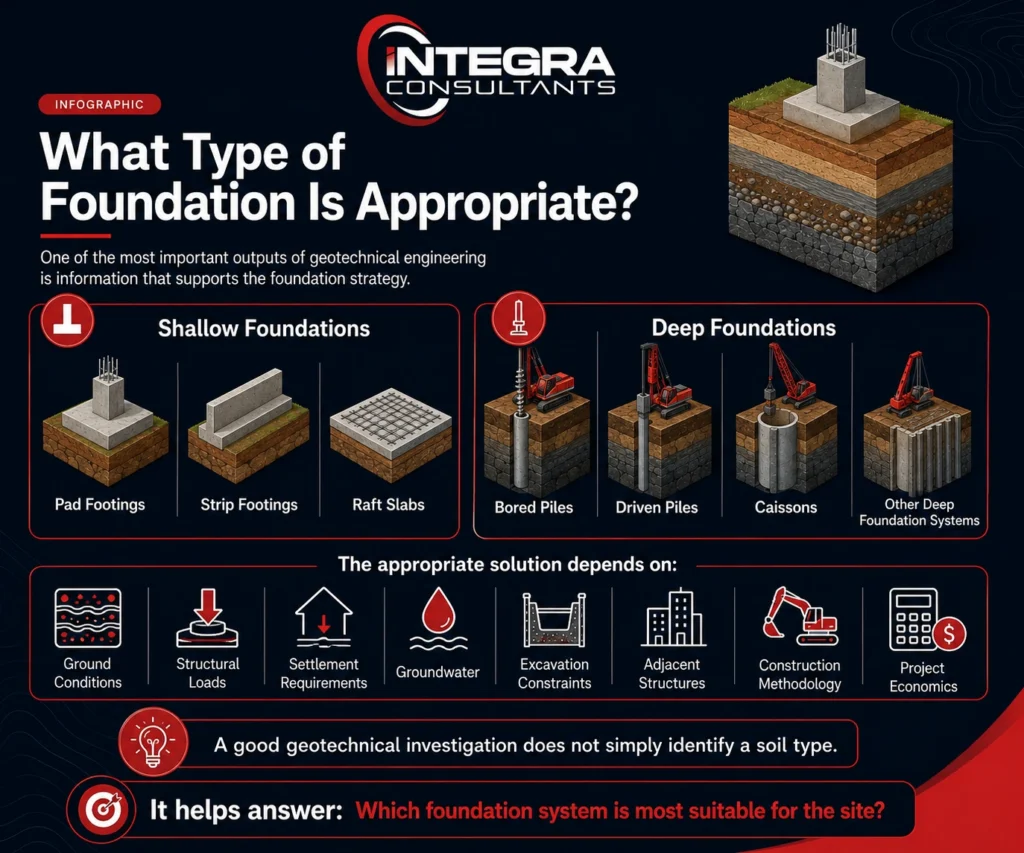
Depending on the ground and structural requirements, options may include:
Shallow foundations
- Pad footings
- Strip footings
- Raft slabs
Deep foundations
- Bored piles
- Driven piles
- Caissons
- Other deep foundation systems
The appropriate solution depends on:
- Ground conditions
- Structural loads
- Settlement requirements
- Groundwater
- Excavation constraints
- Adjacent structures
- Construction methodology
- Project economics
A good geotechnical investigation does not simply identify a soil type.
It helps answer:
Which foundation solution is technically appropriate, practical to construct and commercially reasonable for this site?
7. What happens if you’re building a basement?
The deeper the excavation, the more important geotechnical engineering becomes.
Excavation removes soil and changes the stress conditions within the surrounding ground.
If the excavation is close to an existing building, road, utility or critical asset, ground movement may become a major design consideration.
The investigation may therefore need to support assessment of:
- Soil and rock strength
- Groundwater
- Excavation stability
- Ground movement
- Retaining wall behaviour
- Shoring requirements
- Dewatering
- Settlement
- Neighbouring structures and infrastructure
This is particularly relevant to dense urban development in Sydney.
NSW requirements for regulated shoring designs can also require detailed information about the shoring system, site boundaries, neighbouring structures, services, geological conditions and construction stages. (NSW Government)
This illustrates an important point:
Geotechnical investigation is not simply about producing a soil report. It provides critical information for the engineering design and construction strategy.
Geotechnical investigation is the beginning, not the end
A common misconception is that the geotechnical engineer’s job ends when the investigation report is issued.
For complex projects, the investigation is the beginning of the engineering process.
Why early geotechnical involvement can save money
Geotechnical investigation is sometimes viewed as an additional project cost.
A better way to view it is as an investment in design certainty and risk management.
Consider a project where the structural design has already been completed based on assumed ground conditions.
If later investigation identifies:
- Weak soil
- Unexpected rock
- Uncontrolled fill
- High groundwater
- Deeper founding requirements
- Significant excavation risk
the project may require redesign.
That can affect:
- Structural design
- Architectural layouts
- Foundation systems
- Shoring
- Excavation sequence
- Dewatering
- Construction programme
- Procurement
- Project cost
Early investigation gives the design team an opportunity to respond while there is still flexibility.
The objective is not to eliminate uncertainty.
It is to identify and manage important uncertainty before it becomes an expensive construction problem.
When should you obtain a geotechnical investigation?
For many projects, the best time is before critical foundation, and excavation decisions are finalised.
Early geotechnical input can be particularly valuable where a project involves:
- New buildings
- Major extensions
- Basements
- Deep excavation
- Retaining walls
- Shoring
- Piling
- Ground anchors
- Underpinning
- Groundwater or dewatering
- Sloping sites
- Significant retaining structures
- Ground improvement
- Roads and pavements
- Embankments
- Heavy structural loads
- Sensitive neighbouring buildings
- Underground infrastructure
Early involvement allows the geotechnical engineer to work with the architect, structural engineer, civil engineer and contractor rather than addressing ground problems after the design has already progressed.
What makes a good geotechnical investigation?
A good investigation is not necessarily the one with the most boreholes or the longest report.
It is the investigation that provides reliable information relevant to the actual project risks.
A fit-for-purpose investigation should consider:
The proposed development
What are you building?
Structural loading
How much load will be transferred to the ground?
Excavation depth
How much soil or rock will be removed?
Site constraints
What is located around the proposed excavation?
Groundwater
Could water affect construction or long-term performance?
Ground variability
How much can conditions change across the site?
Consequences of failure
What would happen if ground movement or settlement occurred?
Construction methodology
Can the proposed solution actually be constructed on the site?
AS 1726:2017 provides the framework for effective geotechnical site investigations and includes consideration of soil, rock and groundwater characteristics. (Intertek Inform)
Modern geotechnical engineering goes beyond soil testing
Field testing is essential, but complex projects often require more than test results.
Modern geotechnical engineering can combine:
Site investigation + laboratory testing + engineering analysis + numerical modelling + construction knowledge
For complex ground-structure interaction problems, numerical modelling can provide additional insight into:
- Ground movement
- Excavation behaviour
- Foundation interaction
- Retaining wall response
- Construction staging
- Structural-ground interaction
Integra Consultants currently highlights advanced 2D and 3D ground investigation and finite-element analysis as part of its engineering capability. (EngConf Solutions)
However, sophisticated modelling does not replace good site investigation.
A sophisticated model based on poor ground information can still produce poor engineering decisions.
The quality of the ground model, engineering parameters, assumptions, and construction sequence remains fundamental.
Geotechnical investigation and buildability
Technical design and constructability should be considered together.
For example, a foundation system may work mathematically but be difficult or expensive to construct because of:
- Restricted site access
- Nearby buildings
- Property boundaries
- Existing services
- Groundwater
- Limited working space
- Construction noise or vibration
- Excavation constraints
Similarly, a shoring system may provide adequate structural capacity but still produce unacceptable ground movement for a neighbouring building.
This is why geotechnical engineering should consider both:
“Will it work?”
and
“Can it be built safely and efficiently?”
Integra positions its services around combining technical analysis, site knowledge and construction-focused engineering to improve buildability and manage project risk. (EngConf Solutions)
What can happen if geotechnical investigation is skipped or under-scoped?
Insufficient ground information can contribute to:
Foundation problems
Including excessive or differential settlement.
Unexpected excavation conditions
Such as rock, weak material or groundwater.
Shoring and stability issues
Where the ground model does not adequately represent actual site conditions.
Construction delays
When unexpected conditions require redesign or changes to methodology.
Additional project costs
Through redesign, additional piling, ground improvement, dewatering, or remediation.
Impacts on neighbouring properties
Particularly where excavation causes ground movement.
Approval and compliance complications
Where engineering documentation does not adequately address relevant site conditions or regulated design requirements.
The NSW regulatory framework for shoring and ground anchors demonstrates the level of detail that may be required for excavation-related designs on applicable projects. (NSW Government)
A practical example: why investigation matters
Imagine a proposed three-storey building with a basement on a constrained Sydney site.
From the surface, the site appears straightforward.
A geotechnical investigation, however, identifies:
- Variable fill near the surface
- Dense sand at intermediate depth
- Weathered rock below
- Groundwater close to the proposed basement level
- Existing neighbouring footings close to the boundary
That information changes the engineering conversation.
The team now needs to consider:
Foundation:
Can the building use shallow foundations, or is a deeper solution preferable?
Excavation:
How will the basement be excavated safely?
Shoring:
What retaining system can control ground movement?
Groundwater:
How will water be managed during excavation?
Neighbouring structures:
What level of movement is acceptable?
Construction sequence:
How should excavation and support be staged?
Without the investigation, these decisions would largely be based on assumptions.
With the investigation, they can be based on evidence and engineering analysis.
How Integra Consultants approaches geotechnical engineering
Integra Consultants’ current service offering demonstrates an integrated approach to ground engineering.
Its capabilities include:
- Complete site investigation and soil testing
- Foundation design
- Shoring and retaining-wall design
- Deep excavation and dewatering
- Ground-structure interaction analysis
- Ground improvement
- Slope stability
- Pavement design
- Engineering assessment and certification
Integra also highlights technical capability in advanced 2D and 3D analysis and finite-element modelling for complex engineering problems. (EngConf Solutions)
This integrated capability is particularly useful when a project moves beyond a basic geotechnical report.
For example, the same ground conditions identified during investigation may later need to be considered in:
Foundation design → Excavation design → Shoring → Dewatering → Ground movement → Construction support
This creates continuity between investigation and design rather than treating each engineering activity as a separate exercise.
Seven practical questions to ask before building
Before proceeding with a significant construction project, ask:
1. What is beneath my site?
Do not rely solely on surface observations or neighbouring properties.
2. What are the foundation conditions?
Understand the strength, stiffness, and variability of the founding material.
3. Is groundwater present?
Consider groundwater before finalising excavation and basement design.
4. Will excavation affect neighbouring properties?
Ground movement can be as important as structural capacity.
5. Is there uncontrolled fill or other problematic ground?
Identify potential issues before foundation design is finalised.
6. Is the proposed solution constructible?
Consider access, sequencing, equipment, boundaries, and site constraints.
7. Have the right engineers been involved early enough?
Coordinate geotechnical, structural, civil, and architectural design before critical assumptions become fixed.
Frequently Asked Questions
What is geotechnical investigation in simple terms?
Geotechnical investigation is the process of investigating soil, rock and groundwater conditions beneath a site so engineers can understand how the ground will behave and design appropriate foundations, excavations, retaining systems and other ground-related works.
Do I need a geotechnical investigation before building?
The requirement depends on the type of development, site conditions, structural design and applicable approval requirements. However, geotechnical investigation is particularly important for new buildings, basements, retaining walls, piling, sloping sites, groundwater conditions and developments close to neighbouring structures or infrastructure.
How much does a geotechnical investigation cost?
There is no single price. The cost depends on the site, investigation depth, access, number and type of tests, laboratory testing and the level of engineering analysis required.
A small residential site may require a relatively focused investigation, while a deep basement or major development can require a much more comprehensive investigation.
How long does a geotechnical investigation take?
The programme depends on the scope and site access. Fieldwork, laboratory testing, engineering interpretation and reporting all need to be considered.
For projects with tight programmes, early engagement allows geotechnical work to progress alongside architectural and structural design.
Does every site need the same investigation?
No.
A fit-for-purpose investigation should reflect:
- Project size
- Structural loads
- Excavation depth
- Ground conditions
- Groundwater
- Site constraints
- Neighbouring structures
- Consequences of potential ground movement
The goal is appropriate information for the project risk, not simply more testing.
Final Thoughts: Investigate First. Design with Confidence.
The most important part of a building is not always visible.
The ground beneath it determines how foundations perform, how excavations behave, how groundwater is managed and how construction interacts with surrounding properties and infrastructure.
A professional geotechnical investigation transforms uncertainty beneath the site into engineering information that can be used for better decisions.
The process is straightforward:
Investigate the ground → Understand the risks → Analyse the behaviour → Design the solution → Build with confidence
For Sydney projects, early geotechnical involvement can help identify foundation, settlement, excavation, groundwater, and ground-movement risks before they become costly construction problems.
At Integra Consultants, geotechnical investigation is integrated with foundation design, shoring, retaining walls, deep excavation, dewatering, ground improvement, slope stability and ground-structure interaction analysis. The focus is on providing technically sound and practical engineering solutions that improve safety, buildability and project certainty. (EngConf Solutions)
Don’t design around assumptions. Investigate the ground first.
Integra Consultants
Civil & Geotechnical Engineering Solutions
Sydney, NSW