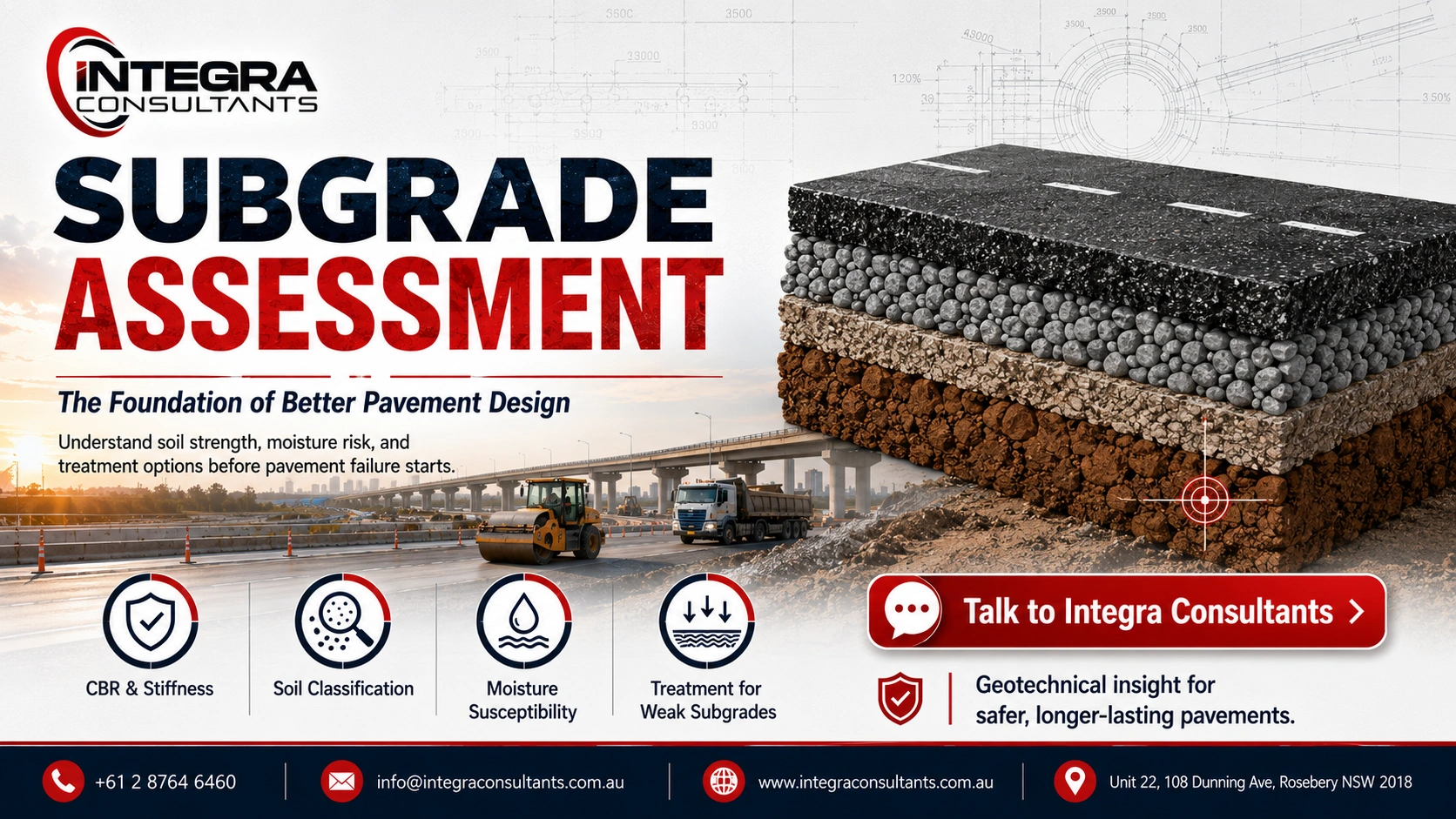
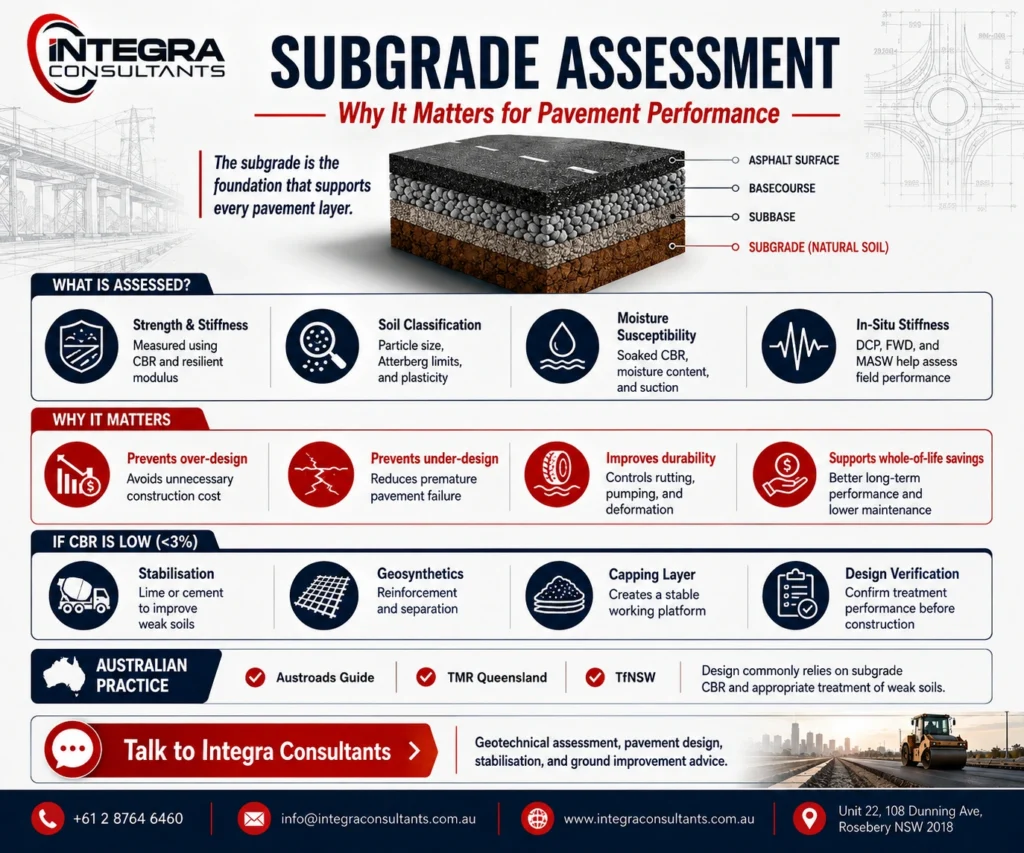
Subgrade Assessment Pavement Design is the systematic process of evaluating the engineering properties of the natural soil upon which a pavement will be built. It matters because the subgrade provides the ultimate support for all overlying pavement layers.
The primary goal of this assessment is to determine the subgrade’s strength and stiffness, most commonly measured using the California Bearing Ratio (CBR) or resilient modulus. A proper assessment helps identify potential problems before construction begins. In Australia, where expansive clays, moisture-sensitive soils, and soft ground conditions can present significant challenges, this step is especially important.
A thorough subgrade assessment helps prevent over-design, which can unnecessarily increase project costs, and under-design, which may result in premature pavement failure. It provides essential engineering data for designing a pavement structure capable of supporting expected traffic loads and environmental conditions throughout its intended design life.
What Are the Key Parameters Investigated in a Subgrade Assessment?
A subgrade assessment is not based on a single test. It usually involves a combination of field investigation, laboratory testing, and engineering interpretation.
Strength and Stiffness
The California Bearing Ratio (CBR) test is one of the most widely used methods in Australia for estimating subgrade strength for pavement design.
The resilient modulus provides a more fundamental measure of soil stiffness and is often used in mechanistic-empirical pavement design. In some design approaches, correlations are used to estimate resilient modulus from measured CBR values.
Understanding both strength and stiffness helps engineers determine how the subgrade is likely to respond under repeated traffic loading.
Soil Classification
Soil classification typically involves tests such as particle size distribution and Atterberg limits, including liquid limit, plastic limit, and plasticity index.
These properties help engineers identify whether a soil is predominantly gravel, sand, silt, or clay and provide important information about its likely engineering behaviour.
Clay-rich soils are particularly important in pavement engineering because some expansive clays can shrink when dry and swell when wet. This repeated movement can contribute to pavement cracking, deformation, and long-term maintenance problems.
Moisture Susceptibility
Subgrade performance is strongly influenced by moisture content.
A soil that performs adequately under relatively dry conditions may lose a significant amount of strength when it becomes saturated. For this reason, soaked CBR testing is commonly used to assess subgrade performance under adverse moisture conditions.
Soil suction may also be considered when evaluating unsaturated soils above the groundwater table, particularly when moisture variation is expected to influence pavement performance.
In-Situ Stiffness
Field testing can provide valuable information about the actual condition of the subgrade.
Devices such as the Falling Weight Deflectometer (FWD) may be used to assess the structural response and stiffness of existing pavement systems.
Other investigation methods, including Dynamic Cone Penetrometer (DCP) testing and geophysical techniques such as Multichannel Analysis of Surface Waves (MASW), can also help identify variations in soil strength and stiffness across a site.
How Do Australian Design Standards Address Subgrade Strength?
Australian pavement design is generally guided by Austroads, with additional requirements and supplements provided by state road authorities such as the Department of Transport and Main Roads in Queensland and Transport for NSW.
Austroads Guidance
The Austroads Guide to Pavement Technology Part 2 provides guidance for pavement structural design and includes procedures relevant to the assessment of pavement materials and subgrade conditions.
Subgrade CBR is an important design parameter in many pavement design procedures. Where subgrade conditions are weak, additional treatments or working platforms may be required before the pavement structure can be constructed.
Mechanistic-empirical pavement design may also use estimated or measured modulus values to represent subgrade stiffness and evaluate pavement response under traffic loading.
TMR Queensland Requirements
The Queensland Department of Transport and Main Roads provides technical specifications covering subgrade preparation, pavement materials, stabilisation, and geosynthetic applications.
Weak subgrades may require treatment before pavement construction. Depending on the project conditions, treatment may involve lime stabilisation, cementitious stabilisation, granular replacement, capping layers, or geosynthetic reinforcement.
The objective is to create a stable and uniform foundation capable of supporting construction equipment and the completed pavement structure.
Transport for NSW Requirements
Transport for NSW also provides requirements for the treatment of weak or moisture-sensitive subgrades.
Where the design CBR is very low, a working platform or improved subgrade layer may be required. Expansive or highly reactive soils may require additional treatment to reduce moisture-related movement and provide a more reliable foundation for pavement construction.
What Happens When Subgrade CBR Is Less Than 3%?
Designing a pavement over a very weak subgrade, such as one with a CBR below approximately 3%, requires special attention.
A very low CBR indicates that the soil has limited bearing capacity and may deform significantly under construction equipment or traffic loading.
In many cases, engineers introduce an improved layer above the weak subgrade so that the pavement can be constructed over a stronger and more uniform working surface.
Common treatment methods include the following.
Stabilisation
Stabilisation involves incorporating suitable binders into the existing soil to improve its engineering properties.
Lime is commonly used for certain clay soils because it can reduce plasticity, improve workability, and decrease swell-shrink behaviour.
Cementitious binders may also be used where increased strength and stiffness are required.
The appropriate binder and treatment rate should be determined through laboratory testing and project-specific engineering assessment.
Reinforcement and Separation
Geosynthetics can be used to improve pavement performance over weak subgrades.
Geogrids can provide reinforcement by improving aggregate confinement and load distribution.
Geotextiles are commonly used as separation layers between weak subgrade soil and granular pavement materials. This helps prevent fine subgrade particles from migrating into the overlying granular layer.
Without proper separation, contamination of the granular material can reduce drainage capacity and decrease the strength of the pavement structure.
Geocomposites may combine reinforcement and separation functions where both are required.
Capping Layers
A capping layer consists of selected granular or improved material placed over the weak subgrade.
Its purpose is to distribute construction loads, create a stable working platform, and protect the pavement layers from excessive deformation.
The required thickness depends on factors such as the subgrade strength, material properties, construction equipment, groundwater conditions, and pavement design requirements.
What Are the Consequences of Inadequate Subgrade Assessment?
Failing to properly investigate and treat a weak subgrade can have serious consequences for pavement performance.
Premature Pavement Failure
A pavement is designed to carry a certain number of traffic load repetitions over its design life.
If the underlying subgrade is weaker than assumed, excessive deformation may occur and the pavement may deteriorate significantly earlier than expected.
Rutting and Deformation
Repeated heavy traffic loads can cause permanent deformation within weak pavement layers or the underlying subgrade.
This deformation may appear at the surface as wheel-path rutting.
Severe rutting can reduce ride quality, affect drainage, and create safety concerns.
Pumping and Material Contamination
Where a weak subgrade becomes saturated, repeated wheel loading may cause fine soil particles and water to move upward into the pavement layers.
This process is sometimes referred to as pumping.
Over time, the granular pavement layer may become contaminated with fine soil particles, reducing its drainage capacity and structural performance.
Increased Whole-of-Life Costs
A geotechnical investigation represents only a relatively small portion of the total cost of most pavement projects.
However, inadequate investigation can lead to expensive repairs, rehabilitation, reconstruction, construction delays, or reduced pavement service life.
Investing in a proper subgrade assessment at the beginning of a project can therefore significantly reduce long-term risk and lifecycle costs.
How Can You Ensure a Successful Subgrade Assessment for Your Project?
A successful subgrade assessment requires a systematic investigation combined with sound engineering judgement.
Engage Experts Early
Geotechnical input should ideally begin during the early stages of project planning.
Engaging experienced engineers early helps ensure that the investigation program is properly targeted and that potential ground-related risks are identified before they affect pavement design or construction.
Integra Consultants provides specialist pavement design services that can help project teams assess ground conditions, interpret subgrade properties, and develop practical pavement solutions suited to project requirements.
Plan a Thorough Site Investigation
A robust site investigation may include a combination of:
- Desktop review of geological and site information
- Site inspections
- Boreholes or test pits
- Dynamic Cone Penetrometer testing
- Groundwater observations
- Soil sampling
- Laboratory CBR testing
- Atterberg limits
- Particle size distribution
- Moisture content testing
- Compaction testing
The investigation should be designed to identify variations across the site rather than relying on a single test location.
Use Advanced Techniques for Complex Sites
More complex projects may require advanced testing or analytical techniques.
For example, geophysical surveys may help assess variations in stiffness across large areas, while numerical modelling such as two-dimensional or three-dimensional finite element analysis may be used to evaluate complex soil-structure interaction or ground improvement options.
These techniques can be particularly useful where conventional pavement assumptions do not adequately represent actual site conditions.
Design and Validate the Treatment
The final pavement design should be based on the results of the subgrade assessment.
Where weak or problematic soils are identified, an appropriate treatment should be designed rather than simply increasing pavement thickness without understanding the underlying problem.
Possible treatments may include:
- Lime stabilisation
- Cementitious stabilisation
- Removal and replacement
- Granular capping
- Geogrid reinforcement
- Geotextile separation
- Improved drainage
- Moisture control measures
Construction verification is equally important.
Field testing, proof rolling, compaction testing, and inspection can help confirm that the treated subgrade performs as intended before the pavement layers are placed.
Conclusion
Subgrade assessment is not simply a box-ticking exercise. It is one of the most important steps in successful pavement design and construction.
Understanding the strength, stiffness, moisture sensitivity, soil classification, and variability of the subgrade enables engineers to design pavement structures that are more reliable, cost-effective, and durable.
For weak or problematic ground conditions, suitable treatment methods such as stabilisation, granular capping, improved drainage, or geosynthetic reinforcement can significantly improve pavement performance.
By undertaking a detailed geotechnical investigation and involving experienced pavement and geotechnical engineers early in the project, owners and designers can reduce construction risks, avoid unnecessary pavement thickness, and minimise the likelihood of premature pavement failure.
Integra Consultants can assist with subgrade investigation, pavement assessment, ground improvement, and pavement design solutions tailored to Australian project conditions.