When you’re developing a Class 2 apartment building in NSW with a deep basement, the shoring design isn’t just a set of drawings; it’s your project’s most important risk management tool. Think of it as a certified plan, created by a specialist geotechnical engineer, that holds back the ground while you dig. It’s what protects your neighbours’ properties, vital public services under the street, and the workers on your site, all while meeting the strict rules of the Design and Building Practitioners (DBP) Act and SafeWork NSW.
Why This Issue Matters: The Hidden Risks Buried Beneath Your Site

Let’s imagine you’ve just secured a great site in Sydney for a new multi-storey apartment complex. Your plans include a three-level basement car park, which means digging down 9 metres. On one side of you is an older apartment block; on the other, a busy road hiding a spaghetti-like junction of water pipes and power lines.
In my experience, I’ve found a project’s biggest risks aren’t on the architect’s blueprints—they’re buried right under your feet. This is exactly where a compliant deep excavation shoring design for a class 2 building in NSW becomes your most critical asset.
The High-Stakes Game of Deep Excavation
It’s all too easy to underestimate the forces you’re dealing with. When I explain this to clients, I often use a simple analogy: imagine you’re digging a big hole at the beach. The moment you dig, the surrounding wet sand wants to slump back in. Now, scale that up. A single cubic metre of packed soil can weigh over 1.7 tonnes. Multiply that by the depth and length of your entire excavation, and the pressures become genuinely enormous.
But it’s not just about stopping a dramatic collapse. The risks are often more subtle and can derail your entire project.
We often see projects run into trouble due to a few key areas. The table below outlines what these risks look like in the real world.
Key Risks in Deep Excavation for Class 2 Buildings
| Risk Area | What It Means for Your Project |
|---|---|
| Damage to Adjacent Properties | Even tiny ground shifts can cause cracks in a neighbour’s foundation or walls. This quickly leads to expensive disputes, legal claims, and stop-work orders from council. |
| Service Strikes | Hitting a water main, gas line, or fibre optic cable means immediate site shutdowns, huge fines, and costly repair bills from utility authorities. |
| Road & Footpath Subsidence | Compromising the ground supporting public infrastructure is a major safety hazard that will get you immediate, and unwanted, attention from the local council. |
| Worker Safety | An unsecured trench is one of the most lethal hazards on a building site. A collapse can happen in an instant, often with tragic outcomes. |
Understanding these risks is the first step toward managing them and keeping your project on track.
The True Cost of Common Mistakes
There’s a good reason the regulations in New South Wales are so strict. Under the Work Health and Safety Regulation 2017, any excavation deeper than 1.5 metres is automatically classified as high-risk construction work. This isn’t just bureaucratic red tape. SafeWork Australia data consistently shows that construction has one of the highest fatality rates, with many incidents tied directly to unsafe excavations.
A common mistake is assuming that a cheap, quick design will save money. In my professional experience, this “she’ll be right” attitude is the fastest path to a project disaster. I’ve seen this lead to massive budget blowouts, crippling delays, and serious legal trouble under the Design and Building Practitioners (DBP) Act, which now holds designers and builders personally responsible.
At Integra Consultants, we believe understanding these risks isn’t about fearmongering. It’s about developing a healthy respect for the ground you’re working on. A professional, compliant shoring design acts as your shield against these hidden dangers, helping ensure your project is safe, on schedule, and ultimately profitable.
Effectively managing the ground is just as crucial as overseeing what is constructed above it. For those interested in solutions for challenging sloped sites, we provide a service in slope stability solutions and design that offers further insight.
How It Is Properly Addressed: Untangling the Web of NSW Regulations
For developers and builders in NSW, the regulatory landscape can feel like a tangled mess. You have SafeWork NSW watching over site safety, the DBP Act demanding accountability, the National Construction Code (NCC) setting technical benchmarks, and local councils adding their own rules. When it comes to a compliant deep excavation shoring design for a Class 2 building in NSW, all these authorities converge on your site boundary.
I often explain this to clients as if we were in a pre-construction meeting. The goal isn’t to get bogged down in jargon, but to understand what each authority needs and why it matters. Getting this right from the start is the difference between a smooth project and one stuck in costly delays.
SafeWork NSW and High-Risk Construction
First, SafeWork NSW classifies any trench or excavation deeper than 1.5 metres as ‘high-risk construction work’. This isn’t a suggestion; it’s a legal classification that triggers specific duties for everyone, especially the builder and developer.
This means you must have a documented safety plan before a single scoop of dirt is moved. The most critical document here is the Safe Work Method Statement (SWMS). For deep excavation, a SWMS must be specific, covering:
-
The unique hazards on your site, like potential trench collapse or hitting underground services.
-
The exact control measures that will be used, such as the specific shoring system designed for the site.
-
A clear description of how these safety measures will be implemented and monitored.
A generic SWMS won’t cut it. It has to be tailored to your site and must directly reference the certified engineering design for the shoring system.
At Integra Consultants, we ensure our shoring designs provide the clear, practical information builders need to develop a robust SWMS. We see the design not just as a structural solution, but as a primary tool for managing site safety.
The DBP Act and Personal Accountability
The introduction of the Design and Building Practitioners (DBP) Act 2020 was a huge shift for anyone working on Class 2 buildings. It places direct, personal responsibility on the professionals who design and construct them. For deep excavations, the implications are profound.
As the Design Practitioner, an independent geotechnical engineer must formally declare that your shoring design complies with the Fair Trading, NCC and all relevant standards. Then, the Building Practitioner (your builder) is legally obligated to build exactly to that declared design. There’s no room for making changes on the fly without going back through the formal declaration process.
This means the shoring design is a legally binding document. For a Class 2 building in NSW, a compliant deep excavation shoring design must be certified and correctly declared from the start. You can learn more about this important process in our detailed information on design certifications as per the DBP Act 2020.
Don’t Forget What Lies Beneath
Before any digging starts, there’s one non-negotiable step: finding out what utilities are buried underground. This is where Before You Dig Australia (formerly Dial Before You Dig) is indispensable. It’s a free service that provides plans from all registered utility owners near your site. Hitting a major water main or a high-voltage cable can be catastrophic.
For example, a deep excavation shoring project for a Class 2 building in NSW requires meticulous compliance with SafeWork NSW rules. As mentioned, excavations over 1.5m deep demand mandatory Safe Work Method Statements (SWMS) and geotechnical supervision. The penalties for non-compliance are severe; SafeWork NSW can issue on-the-spot fines of up to $3,600 for employers and $720 for individuals who breach WHS regulations. This really underscores the importance of doing your homework with Before You Dig Australia.
This complex web of regulations might seem daunting, but it’s manageable with the right approach. A core part of our role at Integra Consultants is to help clients understand and meet these obligations, ensuring the shoring design is not only structurally sound but also fully compliant.
The Role of Integra Consultants: Getting to Know the Ground Beneath Your Feet
Every successful deep excavation project begins long before the first bucket of dirt is moved. It starts with understanding the ground itself. You simply can’t design a solution if you don’t know the problem you’re trying to solve.
This is where a geotechnical investigation becomes your most critical tool. Think of it as a doctor ordering diagnostic tests before prescribing treatment. Guessing what lies beneath your property is a recipe for disaster; a proper investigation turns unknowns into hard data.
What Are We Actually Looking For?
When our engineers at IC begin the design process, their initial task is to review the subsurface. This is generally accomplished by examining desktop studies and analysing geotechnical investigation reports conducted by external parties.
During this process, we’re looking for several key pieces of information:
-
Soil and Rock Layers: First, we identify the different soil/rock layers. Are we dealing with soft clay, loose sand, or Sydney’s tough Hawkesbury Sandstone? Every material behaves differently.
-
Material Strength: We review the geotechnical report that includes the laboratory test results, which indicate how much force the ground can withstand before it shifts—an essential figure for the shoring design.
-
Groundwater Levels: We also need to know if there’s groundwater and how deep it is. Water adds significant pressure and can weaken certain soils, so we absolutely must account for it.
This process gives us the data needed for a safe and cost-effective shoring design. It’s a complex science where we model how the ground and the new structure will behave together, a concept we explore in our services on ground-structure interaction analyses.
Ultimately, understanding the site is crucial to selecting a compliant design.

The flowchart shows that if your site conditions are not fully understood, the only correct path forward is to investigate before you think about design.
Choosing the Right Shoring System for Your Site
Once we have a complete picture from the geotechnical investigation, the next question is: how do we hold it all back safely? There isn’t a single “best” shoring system. The right choice for a compliant deep excavation shoring design for a Class 2 building in NSW is always the one that best suits your specific site.
At Integra Consultants, this is where we blend engineering theory with years of practical, on-the-ground experience. We don’t just default to the strongest or most expensive option. Instead, we recommend the most appropriate and cost-effective solution that a contractor can actually build safely on your site.
Common Shoring Systems Explained Simply
For typical multi-level basements in NSW, several shoring systems are commonly used, each suited to specific ground conditions and associated risks.
Let’s break them down:
-
Sheet Piles: This involves driving prefabricated sections of steel into the ground to form a continuous wall. It is highly effective for controlling water ingress and is ideal for sites with loose or soft soils near bodies of water. For details, visit Meso Solutions.
-
Soldier Piles: These are vertical steel or concrete posts drilled into the ground. As excavation deepens, panels such as timber (lagging) or sprayed concrete (shotcrete) are placed between them to retain soil. This method is versatile and often cost-effective in stable ground like firm clays or rock.
-
Contiguous Piles: This system involves drilling a line of concrete piles side-by-side, leaving a small gap between each one. It is stronger than soldier piles and is suitable for retaining drier, less stable soils where minor water seepage is not a major concern.
-
Secant Piles: For challenging sites, this system constructs an interlocking wall by drilling two sets of piles. First, ‘female’ piles are installed with weaker concrete, followed by ‘male’ piles drilled in between, creating a continuous, nearly watertight wall.
To help visualise which system might be right, here’s a quick comparison.
Shoring System Options for Class 2 Buildings
| Shoring System | Best For… | Key Consideration |
|---|---|---|
| Sheet Piles | Shallow–medium excavations, temporary works, marine/coastal projects, and many typical Sydney sites with fill or sand. | Cost-effective and fast to install; moderate stiffness with good groundwater control via interlocks (can be sealed). Vibro methods cause vibration, but press-in reduces impact. |
| Soldier Piles | Temporary shoring in stable, relatively dry ground above groundwater. | Economical with low vibration (bored), but lower stiffness and poor water cut-off; ground movement between piles must be managed. |
| Contiguous Piles | Permanent or temporary basement walls in sandstone or stiff clays with limited groundwater. | Higher stiffness than soldier piles and low vibration; not watertight due to gaps, so groundwater control is required. |
| Secant Piles | Deep basements, high groundwater, and movement-sensitive urban sites. | Very stiff with strong groundwater cut-off; highest cost and slower construction due to overlapping bored piles. |
Simple Practical Summary
-
Need speed, water control and temporary works? → Sheet piles
-
Need economical temporary support in dry ground? → Soldier piles
-
Need permanent wall with moderate groundwater? → Contiguous piles
-
Need deep excavation with water control and minimal movement? → Secant piles
For many typical Sydney excavations, sheet piles offer a strong balance of cost efficiency, speed, and practical groundwater control, making them a competitive and effective solution when designed and installed appropriately.
Ground–Structure Analysis Provides Detailed Design Insight
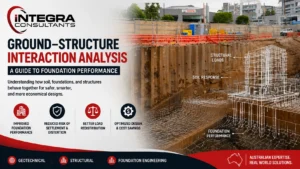
The next stage involves undertaking detailed finite element modelling to assess how the proposed shoring system interacts with the surrounding ground and groundwater conditions. This analysis simulates the staged excavation process, structural installation sequence, and loading conditions to predict soil movements, wall deflections, bending moments, shear forces, anchor loads, and potential ground settlement.
By modelling the soil–structure interaction, the designer can evaluate performance under realistic site conditions rather than relying solely on simplified empirical methods. This enables optimisation of pile embedment depth, section size, anchoring levels, and bracing configuration to achieve a safe, efficient, and cost-effective solution. It also assists in assessing potential impacts on adjacent structures, services, and pavements — which is particularly critical in dense urban environments.
Ultimately, ground–structure analysis reduces uncertainty, improves risk management, and provides confidence that the shoring system will perform as intended throughout construction.

From Blueprint to Reality: Collaboration on the Ground

A compliant deep excavation shoring design for a Class 2 building in NSW isn’t a document you simply file away once council gives it the green light. I’ve always seen it as a living plan—a roadmap that requires careful execution, constant vigilance, and active collaboration on site. The job is far from over when the design is approved; in many ways, the most critical phase is just beginning.
This is where our role at Integra Consultants really shines. The relationship between us as the designers, the builder, and the specialist shoring contractor like MESO Solutions becomes a three-way partnership built on clear communication and trust, ensuring the lines on the drawing translate into a safe structure in the ground.
On-Site Monitoring Isn’t Optional
How is the effectiveness of the design confirmed? By measuring it. This is where construction monitoring plays an essential role. It’s about collecting real-world data to confirm that the shoring system aligns with engineering model predictions.
The process involves the installation of precise instruments to track even the smallest movements. These include:
-
Inclinometers: Placed within the shoring wall to measure any tilting as the excavation progresses.
-
Survey Prisms: Positioned on the shoring wall and adjacent structures, these are used in regular surveys to create a detailed 3D map of any movements, often with millimeter precision.
-
Vibration Monitors: Used when working near sensitive structures to ensure construction activities remain within safe limits.
By following these guidelines, all parties involved—the builder, the council, and the client—can be reassured that the excavation is advancing safely.
Deep Excavation Shoring: Your Questions Answered
As specialist engineers focusing on compliant deep excavation shoring for Class 2 buildings in NSW, we often hear the same practical questions from developers, builders, and project managers. Let’s tackle some of the most common ones with straightforward answers.
How Early Do I Really Need to Bring in a Geotechnical Engineering Consultants?
As early as possible—ideally at the concept or Development Application (DA) stage.
Getting an engineer on board from the beginning lets them flag ground-related risks early and provide input that can genuinely optimise your basement design. This isn’t about ticking a box; it’s about preventing costly redesigns and ensuring your DA submission is built on a feasible foundation strategy. A little upfront advice can save you a mountain of time and money later.
What’s the Biggest Mistake Developers Make with Deep Excavations?
Hands down, the most common and costly mistake is treating the shoring design as a commodity and just chasing the cheapest initial quote. This approach almost always backfires.
You often end up with a generic design that isn’t tailored to your site, is a nightmare to build, or fails to properly manage the risks to neighbouring properties.
A cheap design has a funny way of becoming incredibly expensive. It leads to delays, damage claims from neighbours, or even a complete redesign mid-project. Investing in a thorough, site-specific design from an experienced consultant is always the most cost-effective approach in the long run.
Who is Responsible if the Shoring Causes Damage?
Under the NSW Design and Building Practitioners Act, the allocation of responsibility is clearly defined among the involved parties. The Design Practitioner, in this context the Geotechnical Engineer, holds the responsibility for producing a design that adheres to the necessary compliance standards. Meanwhile, the Building Practitioner, typically the builder, is tasked with the accurate execution of that design during construction. As the developer, you bear considerable risk, as you are ultimately accountable for ensuring that all aspects of the project meet legal standards and safety requirements.
Given these responsibilities, ensuring that you have a thoroughly vetted and certified design, supported by vigilant professional construction monitoring, is of paramount importance. This documentation serves as essential evidence that you have fulfilled your duty of care obligations. To effectively manage these responsibilities, it is crucial to be aware of and understand common pitfalls associated with the process including Sydney Water assets. For more detailed insights on protection on Sydney Water assets, you can explore the A Practical guide on specialist engineering assessment, which delves into many of the fundamental principles crucial for navigating this complex landscape.
Closing Insight
Engaging an experienced engineering consultant early can save significant time, cost, and stress. If your project involves a deep excavation, getting the right advice from the start is the single most important step you can take. At Integra Consultants Pty Ltd, we provide clear, practical engineering advice to ensure your shoring design is safe, compliant, and buildable.
https://integraconsultants.com.au/contact-us/
Written By:
Dr. Tanvir Hossain
Managing Director
Integra Consultants Pty Ltd