A Developer’s Challenge: Constraints in Urban Construction
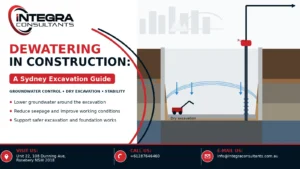
Consider a situation often encountered by developers. You’re tasked with a project on a confined urban site, such as excavating a new basement on the boundary line in a Sydney suburb known for its sandy soil. Everything proceeds smoothly until you face significant issues: there’s no space for piling, vibrations are restricted due to regulatory requirements, or there’s substantial groundwater ingress disrupting the site. These challenges can bring work to a halt. The regulatory bodies may impose restrictions, neighbors might express concerns, and your project timeline and budget could suffer as a result. This scenario underscores a crucial risk in urban construction: the unseen factors beneath the surface can significantly impact your project’s progress and success.
A Modern Fix for a Common Problem
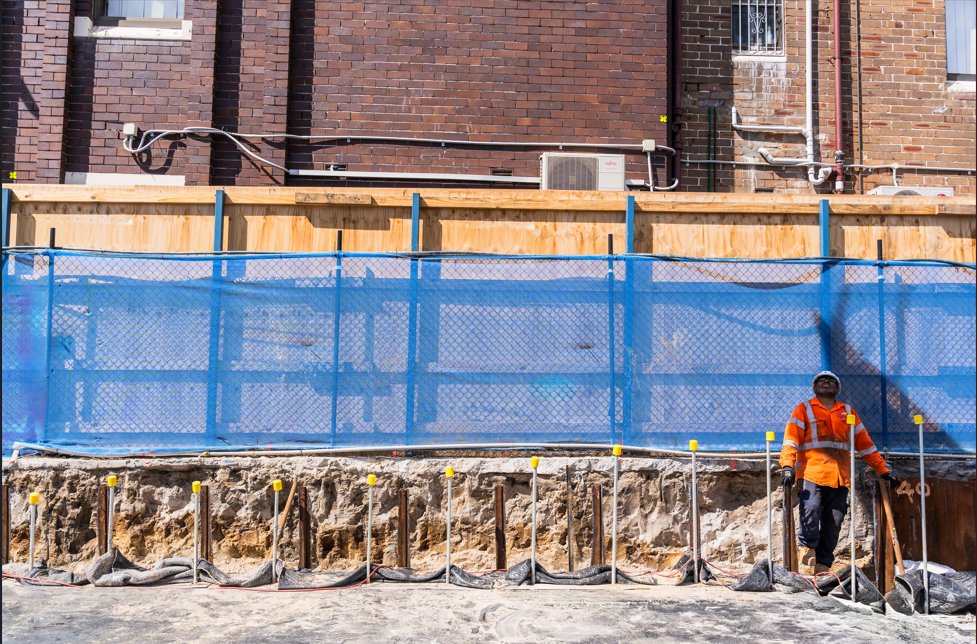
In the past, dealing with unstable ground often meant disruptive and messy underpinning with tonnes of concrete. Thankfully, modern engineering offers a much smarter, more precise solution: permeation grouting.
I often refer to it as **‘keyhole surgery for the ground.’** Rather than large-scale excavation, we design a method where a specialised, low-viscosity liquid grout is injected into the soil through small tubes. This grout moves into the minute spaces between soil particles and solidifies, effectively binding the loose ground into a solid, stable block. It’s an intelligent approach to reinforcing weak ground without the noise, vibration, and disruption of conventional methods.
At Integra Consultants, we see proactive ground improvement design not just as a technical task, but as essential risk management. Stabilising the ground before you excavate is the most reliable way to protect your investment, your schedule, and your relationship with your neighbours.
This process is fundamental to creating a safe site for both your new build and the structures next door. By properly assessing the ground and applying the right solution, we can turn a potential disaster into a solid success.
When Does Permeation Grouting Make Sense?
When a project needs to support an existing foundation or a shallow excavation, the default method for many builders is traditional mass concrete underpinning. It’s the technique everyone knows: dig a hole, pour concrete, and wait for it to cure. But in the tight spaces and sensitive environments of urban construction, ‘traditional’ can quickly become shorthand for slow, noisy, and disruptive.
This is usually when clients ask us, “Why should we consider permeation grouting instead of what we’ve always done?” My answer focuses on keeping the project moving, managing risk, and avoiding headaches with neighbours and councils.
The Quiet Advantage in Sensitive Areas
Imagine your site is next to a heritage-listed building, or directly above a critical Sydney Water main. In these situations, any ground movement is a major problem. The vibration and noise from conventional underpinning or shoring can cause damage, leading to stop-work orders and costly disputes.
Permeation grouting, by contrast, is a remarkably quiet, low-vibration process. Because we are simply injecting a liquid through small tubes, the disturbance to the surrounding area is minimal. This surgical approach is a game-changer when you’re working near sensitive structures where there is zero tolerance for ground settlement.
For projects in dense urban areas, the value of a quiet, low-impact solution can’t be overstated. It protects adjacent buildings, minimises complaints, and allows other site activities to continue without interruption, directly helping your project stay on schedule.
Saving Time and Money Without Compromise
Beyond its gentle approach, permeation grouting offers significant practical advantages in cost and speed. Traditional underpinning is a slow, step-by-step process that involves a lot of digging, formwork, and waiting for concrete to cure. This can drag on for weeks, holding up the entire project.
Permeation grouting is much faster. Once the injection tubes are installed, the grouting work can often be completed in days. In Australia, the economic benefits are well-established, with many projects achieving significant cost savings. For example, stabilising a home foundation—a common issue in Sydney’s coastal suburbs—might take 8-16 weeks with traditional methods. A grouting solution can often achieve the same or better result in just 2-6 weeks, with far less disruption. You can find more technical details from specialists like MESO Solutions.
To help clients see the difference, a simple comparison often makes the choice clear.
Permeation Grouting vs. Traditional Underpinning
| Factor | Permeation Grouting | Traditional Concrete Underpinning |
|---|---|---|
| Disruption | Minimal noise and vibration. Ideal for sensitive sites. | High noise levels and vibration. Very disruptive. |
| Timeline | Typically much faster, with no long curing times needed. | Slower, sequential process delayed by concrete curing. |
| Site Impact | Small equipment and very little excavation required. | Requires significant excavation and space for machinery. |
| Versatility | Excellent for confined spaces and complex ground conditions. | Difficult to implement in tight or restricted areas. |
This comparison highlights why a thoughtful permeation grouting design for underpinning or shallow excavation support is often the smarter strategic choice. It’s not just about strengthening the ground; it’s about doing it in a way that aligns with the commercial realities of modern construction.
How We Design a Grouting Solution
A successful grouting project is not magic; it’s the result of a careful design process that leaves nothing to chance. When clients ask how we develop a permeation grouting design for underpinning or shallow excavation support, I explain that it’s like being a detective. We start with the clues hidden in the ground and build our case from there, moving from understanding the problem to engineering a precise, reliable solution.
A well-designed grouting plan can transform a project’s timeline and budget by saving time, reducing costs, and minimising disruption.
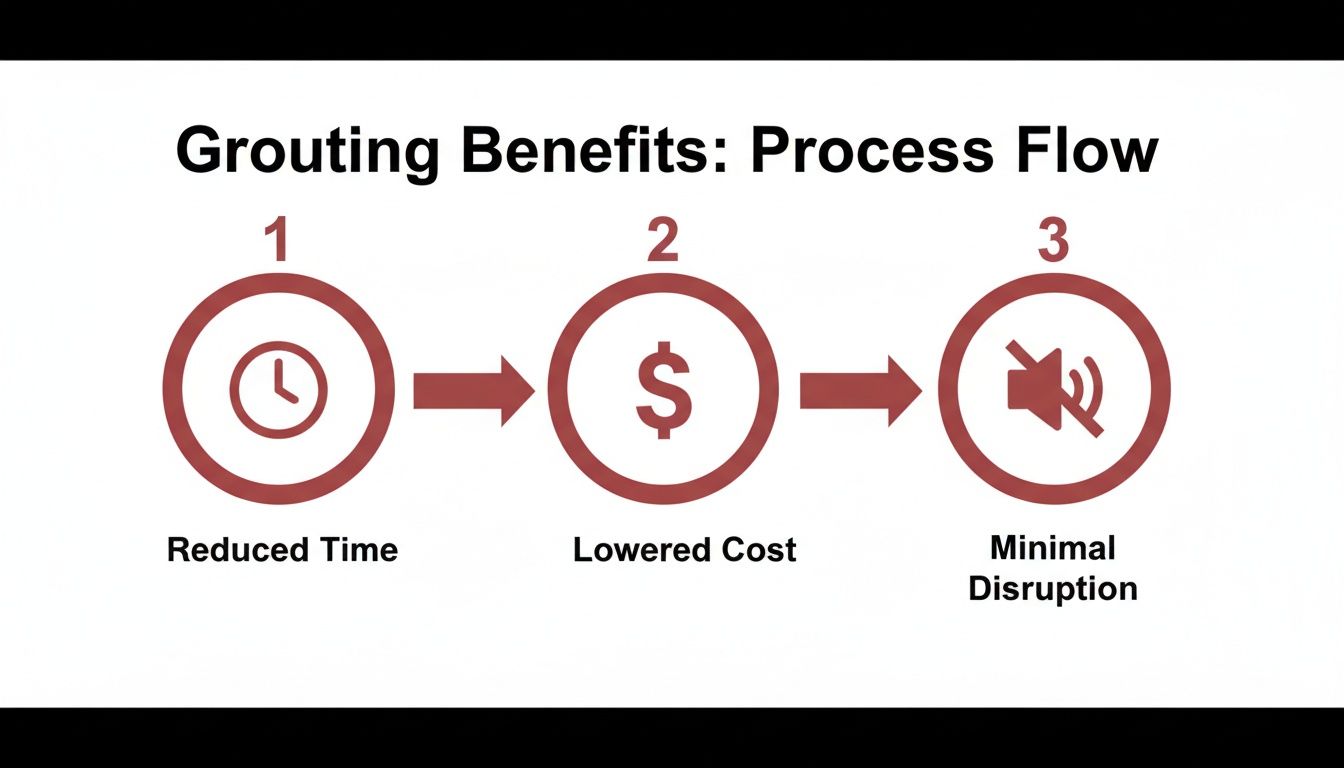
As the diagram shows, the benefits are clear. It’s often a faster, more economical, and less intrusive alternative to traditional methods, especially on complex or congested sites.
Step 1: Understand the Ground
Everything begins with a thorough geotechnical investigation. This is a non-negotiable first step that informs every subsequent decision. We drill boreholes, collect soil samples, and run laboratory tests to understand exactly what we’re dealing with. We need to know the soil type, its density, and most importantly, its permeability. Permeability is simply a measure of how easily liquid can flow through the soil. This single factor tells us whether permeation grouting is a viable option for the site.
Step 2: Select the Right Grout
With a clear picture of the ground conditions, we choose the right grout. Using the wrong one is a recipe for failure, as the choice depends almost entirely on the soil’s particle size.
Here’s our general approach:
- For sandy soils: We typically use microfine cements. These are cement particles ground into an extremely fine powder, allowing them to flow into the relatively large spaces between sand grains.
- For finer soils like silts: Microfine cement is often too large. In these cases, we use chemical grouts like sodium silicates. Their consistency is much closer to water, so they can permeate much finer soils.
Getting this right is fundamental. It ensures the grout can actually get where it needs to go to do its job.
Step 3: Plan the Injection Pattern
Next, we design the injection pattern—the strategic layout of the tubes that will deliver the grout into the ground. I often compare it to watering a garden with a soaker hose. You don’t just stick the hose in one spot; you lay it out carefully to ensure even coverage. We design a grid of injection points, specifying their spacing and depth, to ensure the grout creates a single, solid block of strengthened soil.
A haphazard injection plan can leave weak, ungrouted pockets in the ground, completely undermining the work. The goal is uniformity—creating a consistent block of improved soil that acts as a reliable foundation.
Step 4: Control Pressure, Volume and Mix Design
The final aspect of the design involves managing the injection process. We determine the precise pressures and volumes of grout required for each location. Engineering expertise is crucial here. Insufficient pressure means the grout won’t spread adequately, while excessive pressure can fracture the ground, causing it to lift and potentially leading to more damage than the initial issue.
Our design establishes specific limits, providing the on-site team with clear guidelines to adhere to. This careful regulation safeguards nearby structures and ensures the ground is strengthened without unintended consequences. Our expertise in ground improvement solutions design is based on thorough analysis rather than assumptions.
Additionally, the mix design is critical, consisting of a specific ratio of grout, admixture, and water. This ensures the mixture’s effectiveness and compatibility with site requirements.
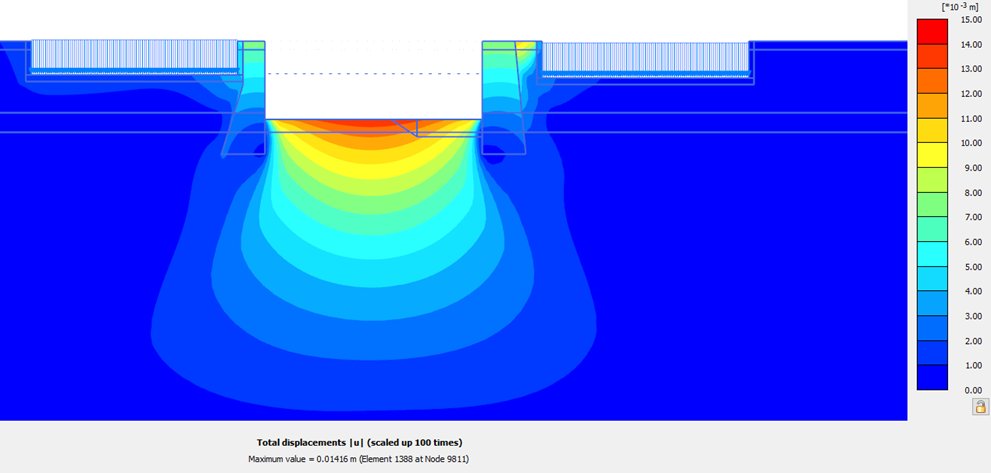
Step 5: Finite Element Modelling – Deflection and Strength Check
In the final step, we input all the data into PLAXIS 2D or 3D software to conduct a thorough assessment. This involves checking the deflection limits, ensuring that the structure’s movements stay within acceptable boundaries. We also examine the moments to ensure that the structural elements are controlled effectively. Additionally, we perform evaluations of both compressive and tensile strengths to confirm the structure can withstand the required stresses.
Common Mistakes and Misunderstandings
In our experience, permeation grouting can achieve remarkable results. However, we are also called in to fix projects where things have gone wrong. Almost every time, the problems stem from a few common misunderstandings that turn a smart solution into an expensive headache. Understanding these pitfalls is the best way to avoid them.
Assuming “Grout is Grout”
One of the most common mistakes is the belief that any grout will do. A builder might assume a standard cement mix is fine for sandy soil, not realising the cement particles are physically too large to flow between the sand grains. Instead of binding the soil, the grout either sits uselessly on the surface or fractures the ground when pumped under high pressure.
We once reviewed a project where a contractor tried to underpin a heritage wall with a standard cement grout. It failed completely. The grout couldn’t penetrate the fine sand, and the high pressure they used actually lifted the ground, cracking the very wall they were trying to save.
The grout must be precisely matched to the soil. Using microfine cement for sands or chemical grouts for silts isn’t an optional upgrade; it’s a fundamental requirement for a successful permeation grouting design.
Proceeding Without Enough Ground Data
Another common mistake is skimping on the geotechnical investigation to save a few dollars. A design based on incomplete or inaccurate soil data isn’t a design—it’s a guess. You cannot create a reliable permeation grouting design for underpinning or shallow excavation support without knowing exactly what you’re injecting into.
Without proper borehole logs and lab tests, you’re flying blind on key factors like soil permeability and strength. This can lead to:
- Incorrect Grout Selection: Choosing a grout that can’t penetrate the soil.
- Ineffective Injection Patterns: Spacing grout tubes too far apart, leaving weak spots.
- Unforeseen Delays: Hitting unexpected rock or clay that halts work.
Trying to cut corners here is a false economy. The cost of a thorough site investigation is a tiny fraction of the potential cost of project delays, rework, or failure.
Choosing a Contractor on Price Alone
When reviewing quotes, it’s tempting to choose the lowest price. However, a suspiciously cheap quote often reflects a lack of experience, poor quality materials, or a misunderstanding of the design. Specialist grouting is a technical craft, not a commodity.
An inexperienced operator may not have the right equipment to control injection pressures, risking ground fracture. They might cut corners on quality control, leaving you with a treated zone that doesn’t meet the required strength. At Integra Consultants, we help our clients avoid this by providing detailed design specifications, ensuring all contractors are quoting on the same high standard of work. These principles apply to all ground engineering, which is why we’ve also written about common mistakes to avoid when designing retaining walls.
Investing in a robust engineering design and partnering with MESO Solutions shifts the focus from short-term savings to long-term value and project success.
Ensuring Success On-Site with Quality Control
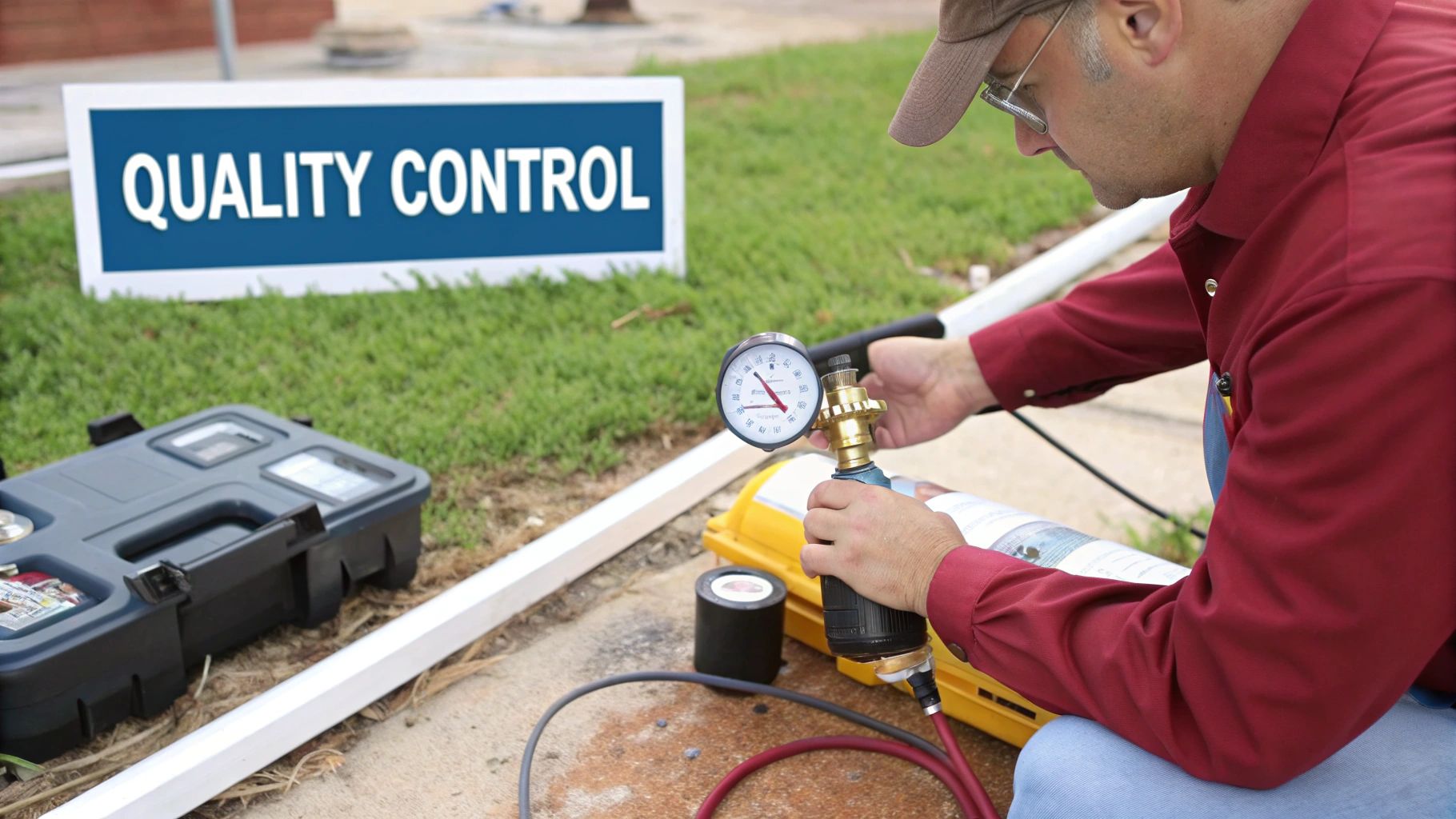
A great permeation grouting design is the blueprint, but a blueprint is only as good as the team building it. This is where engineering theory meets construction reality. A rigorous quality assurance process is essential to bridge that gap. It’s how we ensure the solution designed in our office is the one being built in the ground, guaranteeing the project’s long-term safety.
This isn’t about looking over a contractor’s shoulder; it’s a collaborative process of checking and confirming at every critical stage. For our clients, this provides peace of mind that their investment is protected and the engineering solution is performing as intended.
How We Monitor and Verify the Work
Quality control begins the moment work starts on site. We implement a strict monitoring plan to track key indicators, giving us real-time data on how the ground is responding.
The main things we monitor include:
- Ground Movement: Using precise surveying equipment, we watch for any movement in adjacent buildings. The goal is zero movement, confirming the grouting is supporting the ground, not disturbing it.
- Grout Flow and Pressure: We verify that grout is injected at the exact pressures and volumes specified in the design to ensure it permeates correctly without causing ground heave.
- Grout Volumes: We record the volume of grout injected at each location. This data tells us if the grout is flowing as expected and helps build a picture of the treated soil.
Final Checks for Final Confirmation
The final step is to prove the ground has achieved the required strength. Once the grout has cured, we conduct tests to verify the outcome. This involves collecting hard data to confirm success.
Verification methods can include:
- Core Sampling: We can drill into the treated ground to extract physical cores for laboratory strength testing.
- In-Situ Testing: We can also use techniques like Cone Penetration Testing (CPT) to measure the strength of the improved ground on site.
This final verification provides a clear, defensible record that the ground improvement has met the design specification, turning a complex engineering design into a successful result for our clients.
Compliance with the Design and Building Practitioners Act
The Design and Building Practitioners (DBP) Act in NSW has rightly raised the bar for accountability. As registered professional engineers, Integra Consultants delivers fully certified designs that meet all DBP requirements. For our clients, this provides a critical layer of confidence. When you submit one of our designs, the council sees it has been prepared and declared by a qualified practitioner who stands behind its safety and compliance with the Building Code of Australia.
Engaging an experienced engineering consultant early is the key to a predictable approvals process. We provide the robust engineering evidence that gives regulators the confidence to say “yes”.
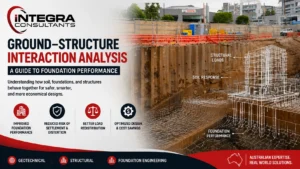
Our expertise in modelling the complex relationship between structures and the ground is central to this. We deliver highly detailed assessments of any potential impacts, which you can explore further in our work on ground-structure interaction analyses. Ultimately, having Integra Consultants in your corner means you are walking into the approval process with a compliant, clear, and defensible plan.
Common Questions About Permeation Grouting
Here are a few common questions we hear from clients when they are considering permeation grouting.
How do I know if permeation grouting will work on my site?
This all comes down to the soil. Permeation grouting works best in granular soils like sands and gravels. It is less effective in fine silts and clays because the grout can’t flow into the tiny spaces. The only way to know for sure is with a proper geotechnical investigation. This allows us to analyse the soil and give you clear, practical advice on the best ground improvement technique for your project.
Will this cause a major disruption to my site and the neighbours?
This is one of the biggest advantages of the technique. Compared to traditional underpinning or piling, permeation grouting is very low-impact. It is a quiet process with minimal vibration, making it ideal for built-up urban areas or sites next to sensitive buildings. The equipment also has a small footprint, so other site work can often continue without interruption.
What is included in a permeation grouting design package?
When Integra Consultants prepares a design, we provide a complete, construction-ready package. You can expect it to include:
- A thorough review of the geotechnical investigation.
- Clear justification for the selected grout type.
- Detailed plans showing the layout, spacing, and depth of all injection points.
- Specific limits for injection pressures and volumes.
- A full quality assurance and monitoring plan for on-site work.
We also ensure all documentation needed for council approval and DBP Act certification is included, delivering a design that is practical, effective, and fully compliant from day one.
Navigating the complexities of ground engineering is what we do. If you’re planning a project involving underpinning or excavation support, engaging an experienced engineering consultant early can save significant time, cost, and stress.
Reach out to Integra Consultants Pty Ltd or Meso Solutions (Attn: Thomas Jennings “tjennings@mesos.com.au) to discuss how we can deliver a practical and compliant design for your project. Visit us at https://integraconsultants.com.au.
Author:
Dr. Tanvir Hossain
Managing Director
Integra Consultants Pty Ltd