Deep excavations have always carried a certain level of risk, but modern Sydney construction has made that challenge far more complex than it was even a decade ago. Basement excavations are now routinely constructed beside ageing buildings, buried utilities, rail corridors, and sensitive authority infrastructure. In many parts of Sydney, there is barely enough room to move equipment, let alone manage excessive wall movement or unexpected ground behaviour.
For years, traditional grouted tieback anchors were considered the standard solution for supporting sheet pile walls. They remain technically sound systems and still perform extremely well on many projects. However, they were developed during a time when construction sites generally had more working space, fewer buried services, and less pressure on excavation sequencing.
Today, the excavation environment is different. Developers want faster programmes, authorities expect tighter movement control, and contractors often need to work within highly constrained urban sites. That shift has gradually pushed the industry towards lower-disturbance support systems that can be installed and verified more efficiently.
One system increasingly used across NSW is the helical anchor.
At first glance, a helical anchor looks deceptively simple. It resembles a steel shaft fitted with one or more circular plates that are rotated into the ground behind the sheet pile wall. Yet behind that simplicity is a highly engineered anchoring system capable of mobilising significant pullout resistance while generating relatively little disturbance during installation.
Top-tier ground engineering companies such as MESO Solutions Pty Ltd now extensively use helical anchors for temporary retention systems across Sydney, particularly on projects where movement control, constructability, and construction sequencing become just as important as the anchor capacity itself.
The growing popularity of helical anchors is not simply about speed. It is largely about predictability. On many constrained urban projects, engineers are increasingly looking for systems that can engage support earlier, reduce unnecessary ground disturbance, and provide immediate verification during construction.
A Short History of Helical Anchors
Interestingly, helical anchors are far older than many people realise.
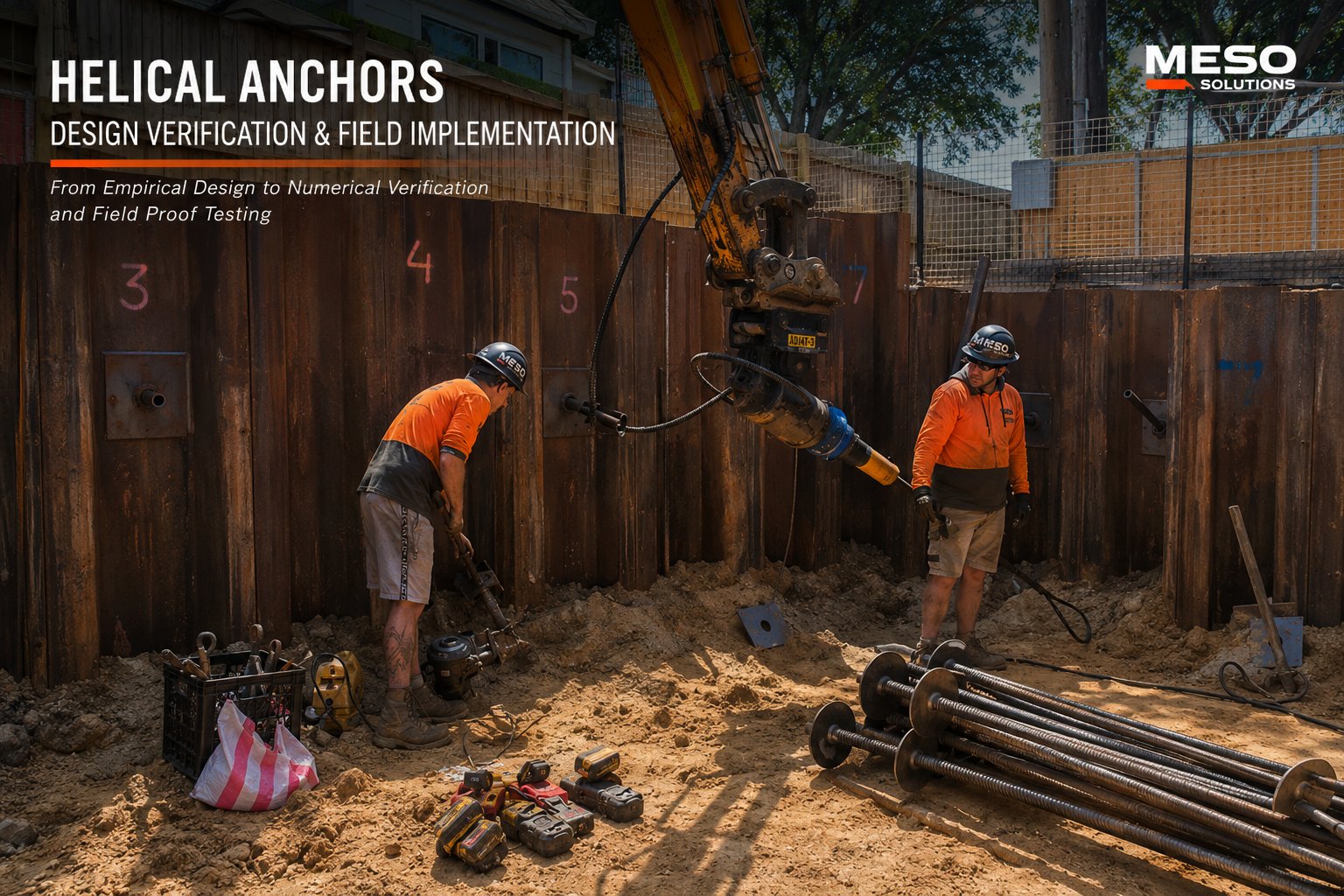
The concept dates back nearly two centuries. Early forms of helical foundations were used in the 1800s for lighthouse construction in weak coastal soils where traditional masonry foundations struggled to remain stable. Engineers discovered that steel shafts fitted with helical plates could be screwed into the ground and develop surprisingly high resistance through the surrounding soil.
Over time, the technology evolved into a range of applications including marine foundations, transmission tower anchors, foundation piles, retaining wall systems, and eventually excavation support systems.
In Australia, the wider use of helical anchors accelerated as urban construction became increasingly constrained. Sydney in particular created ideal conditions for their adoption. Deep basement excavations were being carried out on narrow sites surrounded by neighbouring buildings, buried services, and groundwater challenges. Large drilling rigs, spoil handling, grout plants, and extended curing periods became increasingly difficult to manage efficiently within these environments.
Contractors and designers gradually recognised that helical anchors solved several practical construction problems at once. Installation generally required smaller equipment, produced very little spoil, and avoided many of the wet works associated with conventional grouted systems. More importantly, the anchors could often be proof tested and brought into service shortly after installation.
That capability significantly changed how excavation support systems could be sequenced during staged basement construction.
Why Sheet Pile Walls Need Anchors in the First Place
To understand why helical anchors became valuable, it first helps to understand how sheet pile walls behave during excavation.
As soil is excavated from inside the site, the retained ground outside naturally tries to move towards the excavation void. This movement generates lateral earth pressure against the sheet pile wall, causing the wall to deflect inward. If wall movement becomes excessive, the consequences can extend well beyond the excavation itself. Ground settlement may begin developing behind the wall, potentially affecting neighbouring buildings, buried pipelines, road pavements, or nearby authority infrastructure.
In urban Sydney conditions, the concern is often not whether the sheet pile wall itself will structurally fail. The greater concern is usually controlling movement before damage occurs elsewhere. Anchors are installed to restrain the wall and reduce that lateral deflection. In simple terms, the sheet pile wall attempts to bend inward under soil pressure while the anchors pull it back into the retained ground behind the excavation.
The earlier the support system becomes active during excavation staging, the earlier wall movement can be controlled. This seemingly simple construction sequencing issue is one of the main reasons helical anchors are becoming increasingly attractive on constrained excavation projects.
How Helical Anchors Actually Work
One of the biggest misconceptions about helical anchors is that they are simply lightweight screw anchors suitable only for small structures. In reality, properly designed helical anchors behave very differently from conventional grouted tieback systems and can develop substantial pullout resistance when installed in suitable ground conditions.
Traditional grouted anchors primarily rely on grout-to-ground bond strength. After drilling is completed, grout is injected around the anchor tendon, and the surrounding soil or rock develops resistance through bond interaction along the anchor length. The performance of the system depends heavily on drilling quality, grout integrity, curing, and bond development within the ground.
Helical anchors transfer load differently.
Rather than relying primarily on grout bond, the anchor develops resistance through one or more steel helix plates acting in bearing against competent soil layers. As the anchor rotates into the ground, the helix plates effectively screw through the soil mass in much the same way a timber screw advances through wood.
For temporary sheet pile retention systems in NSW, contractors commonly use single or double helix anchors with approximately 250 mm diameter helix plates connected to 51 mm rods or square shaft systems. Depending on excavation geometry and retained height, the anchors are typically installed between 10° and 45°. The system performs particularly well in medium dense to dense sands and stiff clays, which are common across many Sydney excavation sites.
Once tensile load is applied from the sheet pile wall, the helix plates mobilise bearing resistance against the surrounding soil mass. This resistance mechanism differs fundamentally from conventional grouted systems and also changes how engineers assess and verify anchor performance.
Why Helical Anchors Often Reduce Wall Deflection
In deep excavation engineering, excessive wall movement is often a far bigger concern than ultimate structural strength.
Traditional grouted anchors usually require drilling, grout injection, curing time, and staged stressing before full support resistance can be mobilised. During that waiting period, excavation may continue while the wall is still deforming under lateral earth pressure. Even relatively small additional wall movement can influence surrounding ground behaviour, particularly near sensitive structures or buried utilities.
Helical anchors significantly change this construction sequence.
Because the system does not depend on grout curing, the anchors can often be proof tested and tensioned shortly after installation. This allows support forces to engage earlier during staged excavation works. Earlier restraint generally means lower wall deflection and improved settlement control behind the excavation.
On constrained Sydney projects, that reduction in movement can become extremely valuable. A technically adequate anchor system may still create project risk if support activation occurs too late in the excavation sequence.
This is one reason helical anchors have become increasingly attractive near neighbouring buildings, rail infrastructure, buried utilities, and Sydney Water assets where movement tolerances are often extremely tight.
Why Helical Anchors Suit Constrained Sydney Sites
Many modern Sydney excavation sites share the same difficulties. Access is limited, boundaries are tight, groundwater is often present, and neighbouring infrastructure leaves little tolerance for unnecessary disturbance. Traditional drilled anchor systems can become difficult under these conditions because they typically require larger drilling equipment, spoil removal, grout handling, and additional construction staging areas.
Helical anchors simplify many of these challenges.
The anchors are generally installed using relatively compact equipment, producing minimal spoil and significantly less site disruption during installation. Because there is little wet work involved, the process also reduces many of the logistical complications associated with grout management and curing. This becomes particularly important near authority infrastructure and buried services where unnecessary disturbance can complicate approvals and increase construction risk.
Projects requiring Specialist Engineering Assessments (SEA) near Sydney Water assets often benefit from lower-disturbance installation methods because reduced ground disturbance generally lowers the risk of asset movement during excavation works.
For contractors working within highly congested urban environments, the attraction of helical anchors is therefore not simply installation speed. It is the ability to maintain tighter control over excavation behaviour while simplifying construction logistics at the same time.
Helical Anchor Design Verification and Field Implementation Sequence
The design and implementation of inclined helical anchors for temporary shoring applications generally involve a staged engineering verification process combining empirical calculations, numerical modelling and field validation.
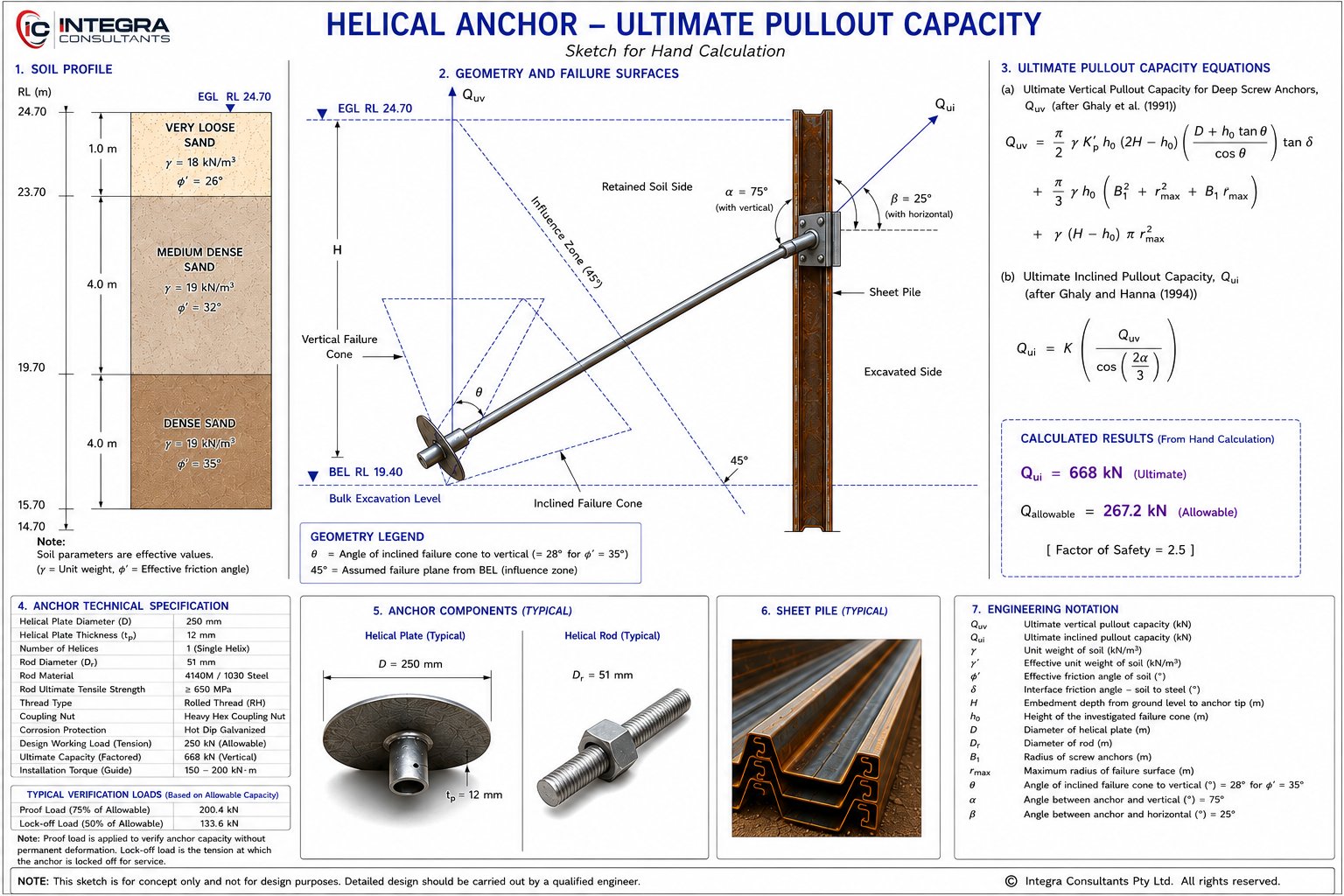
Step 1 – Empirical Hand Calculation of Ultimate Pullout Capacity
Once the site soil profile and temporary sheet pile wall geometry are established, the preliminary ultimate pullout capacity of the helical anchor is evaluated using empirical and theoretical equations available in published literature. The calculation process considers soil stratification, anchor inclination, helical plate geometry, failure cone development and influence zones behind the retaining system.
For this purpose, Integra Consultants developed a conceptual hand-calculation procedure based on the methodologies proposed by Ghaly et al. (1991) and Ghaly & Hanna (1994) to estimate the ultimate vertical and inclined pullout capacities of the anchor system. The conceptual procedure developed by Integra Consultants is illustrated below.
Step 2 – Numerical Verification Using PLAXIS 3D
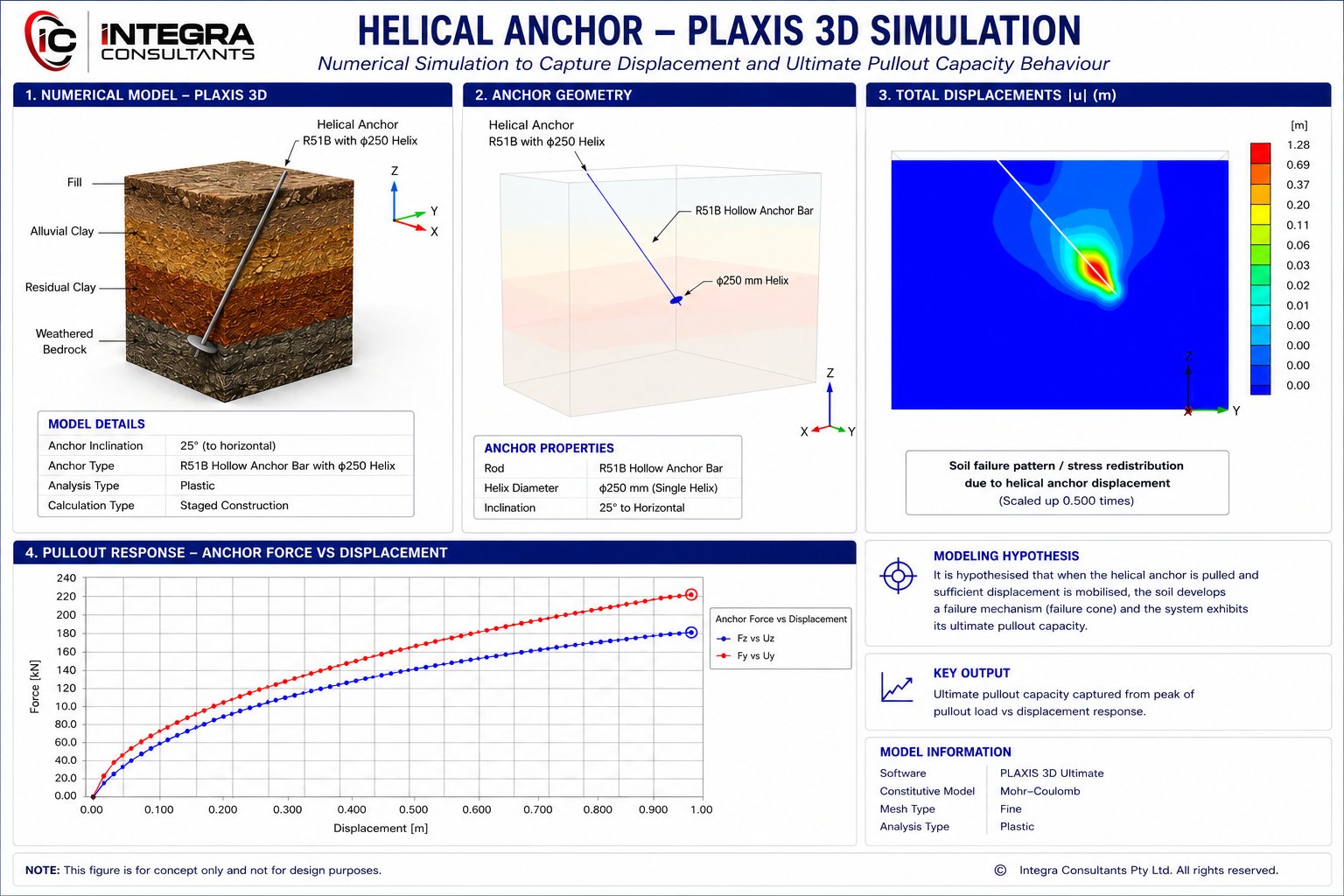
Following the empirical assessment, the anchor behaviour is further investigated using finite element analysis (FEA) in PLAXIS 3D. The purpose of the numerical model is not necessarily to directly reconcile with the empirical calculation, but rather to observe the soil failure mechanism, stress redistribution and pullout behaviour associated with anchor displacement.
In the numerical simulation, the inclined helical anchor is modelled within the subsurface profile and progressively displaced along its axis to mobilise pullout resistance. The simulation allows visualisation of cone-shaped soil failure patterns surrounding the helical plate together with displacement contours and stress redistribution within the ground mass.
The PLAXIS 3D sample results prepared by Integra Consultants are presented below.
Step 3 – Field Installation, Proof Testing and Lock-Off Prestressing
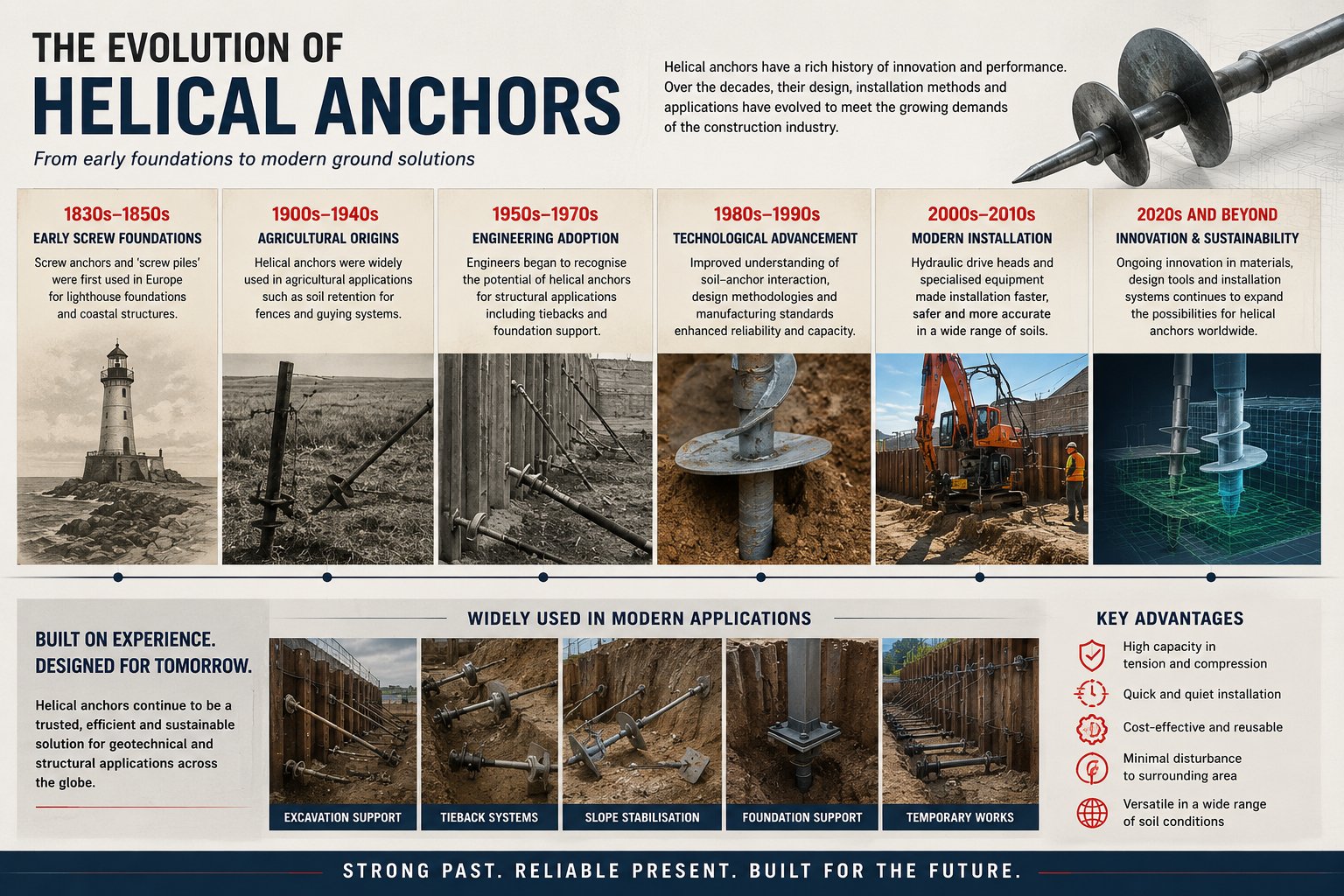
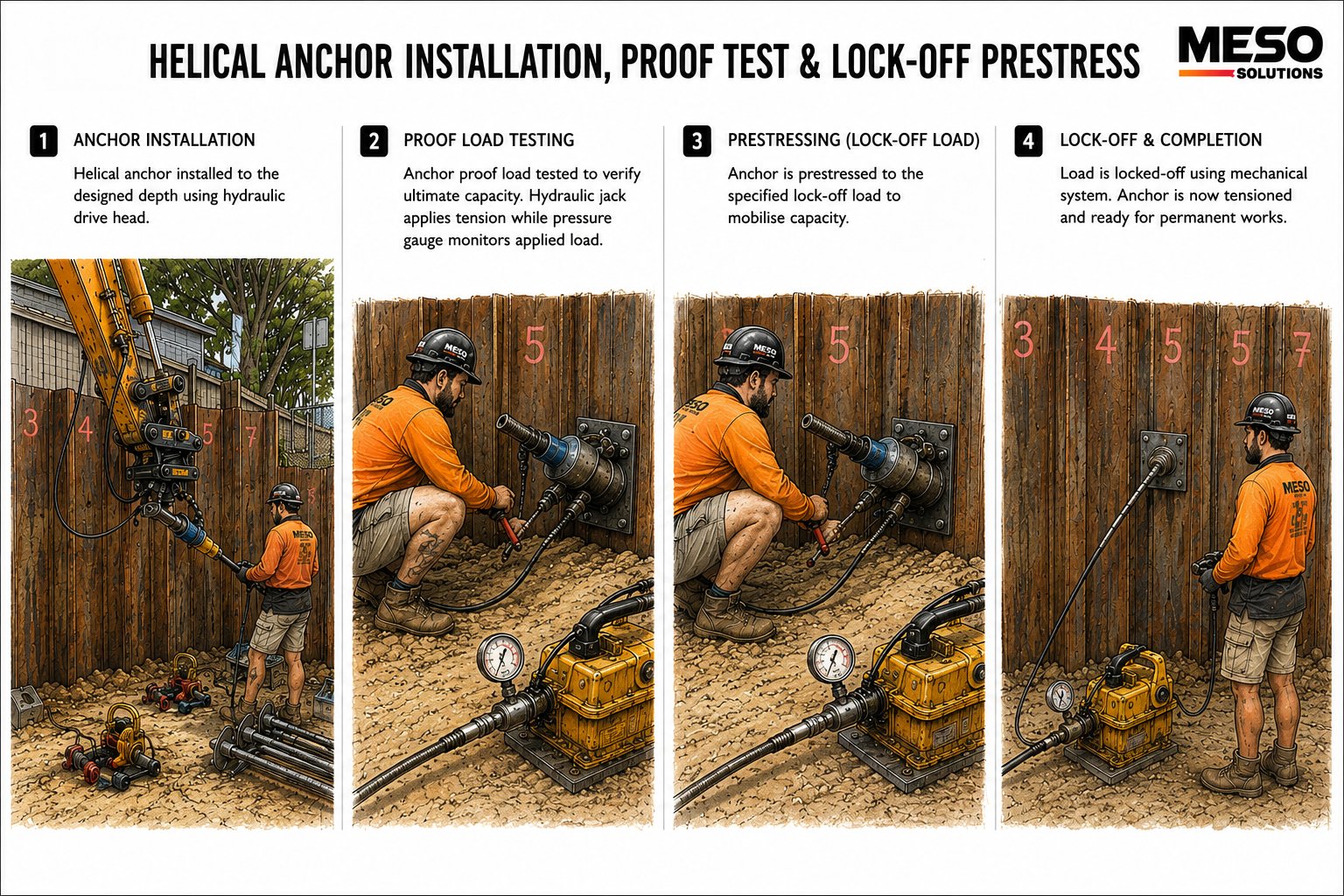
After the design verification process is completed and required design lock-off load is determined, companies with design and construct capability like MESO Solutions Pty Ltd undertakes field installation of the helical anchor system using hydraulic drive equipment. The anchors are installed at the specified inclination and embedment depth in accordance with the project requirements.
Following installation, proof load testing is carried out to verify the anchor performance and confirm the required pullout resistance. The anchor system is then prestressed and locked off at the nominated lock-off load to minimise wall deflection and maintain the required level of retained ground support during excavation works.
A typical field installation, proof testing and lock-off sequence undertaken by MESO Solutions Pty Ltd is illustrated below.
Helical Anchors vs Traditional Grouted Anchors
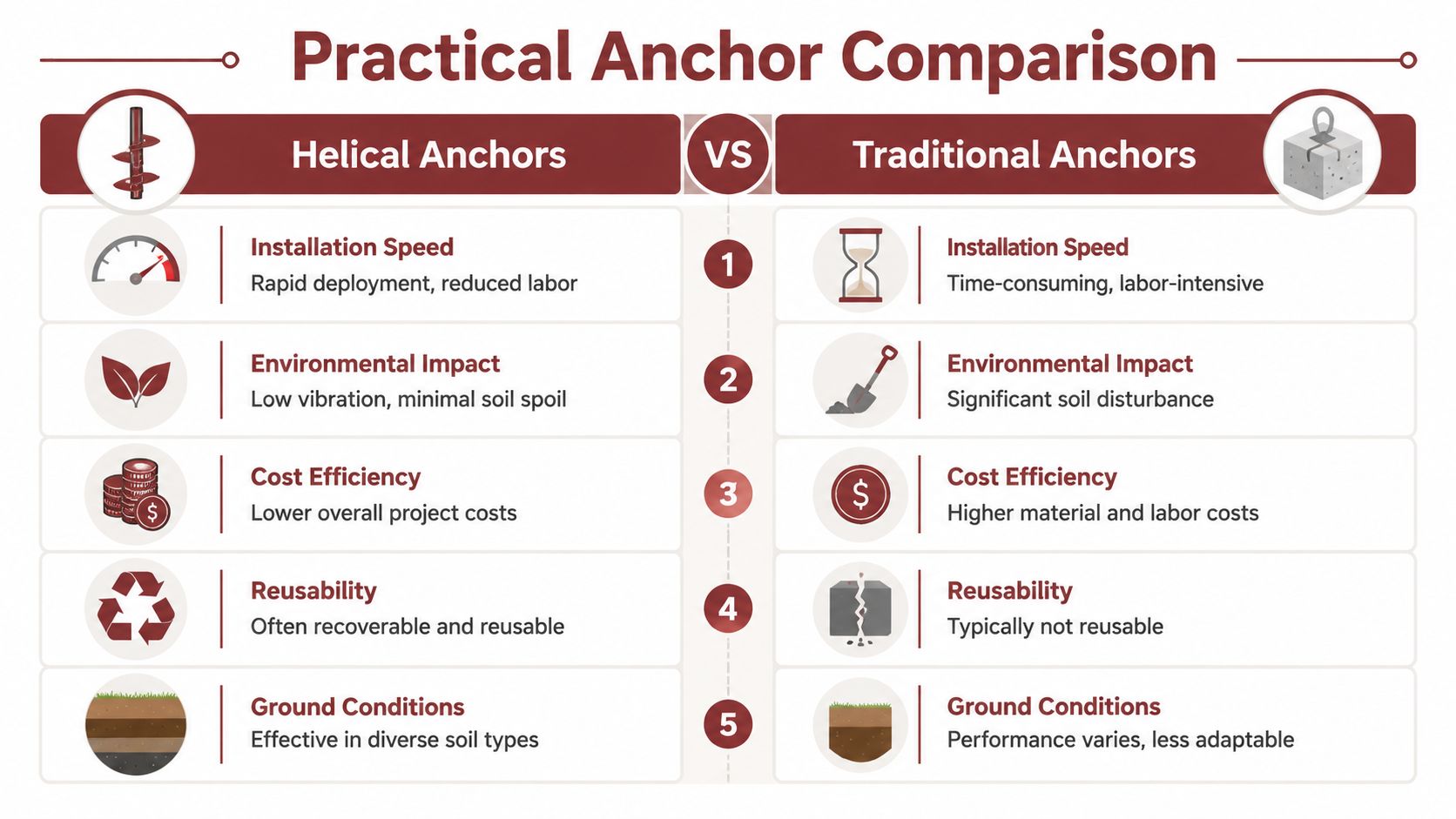
The discussion between helical and grouted anchors should never be reduced to one system being universally superior. Both systems have appropriate applications, and both can perform extremely well when used under suitable conditions.
Traditional grouted anchors still remain highly effective for very high load applications, difficult geological profiles, and deep rock anchorage conditions. In many permanent retention systems, they continue to provide excellent long-term performance.
Helical anchors, however, offer important advantages where urban constructability, reduced disturbance, and earlier support activation become critical project drivers.
They are particularly well suited to constrained excavation environments where:
-
movement control is critical
-
access is restricted
-
spoil handling is difficult
-
nearby assets are sensitive
-
rapid sequencing is important
At the same time, helical anchors are not universal solutions. Very loose uncontrolled fill, heavily obstructed ground, highly compressible soft clay, or projects requiring deep rock anchorage may still favour conventional drilled systems.
Good engineering judgement remains essential.
The success of any anchor system still depends on proper geotechnical investigation, realistic soil parameters, construction staging, and careful field verification.
Final Thoughts
The growing use of helical anchors across Sydney and NSW reflects a broader shift occurring throughout urban excavation engineering.
Construction sites are becoming tighter, excavation risks are increasing, and project teams are under greater pressure to control movement while maintaining efficient construction sequencing.
In that environment, engineers are increasingly looking for anchoring systems that combine practical constructability with reliable field performance.
For suitable soil conditions, helical anchors can provide substantial advantages in temporary sheet pile retention systems by reducing disturbance, improving installation efficiency, and allowing earlier verification of support performance.
But perhaps the most important lesson is that successful excavation support is rarely about selecting a single “best” product.
Good retention design comes from understanding how the ground, wall, anchor system, groundwater, and construction sequence all interact together throughout the excavation process.
That broader understanding is what ultimately protects neighbouring structures, controls wall movement, and keeps excavation projects moving safely and efficiently through construction.
If your project involves sheet piling, deep excavation, groundwater control, or sensitive assets in NSW, contact Integra Consultants Pty Ltd for specialist engineering advice.
Written By:
Dr. Tanvir Hossain
Managing Director
Integra Consultants Pty Ltd