
For a private sector developer in NSW, successful pavement design for flexible and rigid surfaces is about creating a durable, compliant, and cost-effective asset. It involves choosing between asphalt (flexible) or concrete (rigid) based on site-specific soil conditions, expected traffic loads, and long-term performance goals, all while meeting local council and Australian Standards requirements.
Why Your Pavement is Your Project’s First Impression
As a developer in NSW, have you ever stopped to think about the first thing people experience at your new site? It isn’t the building lobby or the landscaping. It’s the driveway, the car park, or the access road. These surfaces set an immediate tone for quality and care, influencing how residents, customers, and even council inspectors perceive your entire project.
The central decision often boils down to choosing between ‘flexible’ pavement (think asphalt) and ‘rigid’ pavement (think concrete). Make the right choice, and you have a long-lasting, low-maintenance asset. But a misstep here can lead to a cascade of problems: costly council rejections, frustrating construction delays, and a future plagued by repair bills that slowly erode your return on investment.
It’s More Than Just Following a Manual
Here at Integra Consultants (IC), we often explain it to our developer clients like this: think of this article as a pre-project meeting, where we clarify that the real key isn’t just picking a material, but engineering the entire pavement system from the ground up.
Of course, the Austroads pavement design guide provides the core technical rules. It rightly points out that performance hinges on design, materials, and construction quality. However, these technical guides can’t capture the specific cost-benefit trade-offs or practical, on-the-ground challenges that private developers face daily in NSW.
Our approach bridges that gap by focusing on what truly matters for your project’s success:
-
Starting with Your Land: We begin with a deep dive into your site. Its unique soil conditions, drainage patterns, and the traffic you anticipate are the non-negotiable foundations that must drive the design.
-
Navigating Council Approvals: We ensure the design ticks every box for local government and Australian Standards. This isn’t just about compliance; it’s about preventing approval roadblocks that can stall a project indefinitely.
-
Focusing on Long-Term Value: We look at the whole picture. We help you balance the initial construction cost against future maintenance needs to deliver a solution that makes financial sense over the entire lifecycle of your asset.
Engaging an experienced engineering consultant early can save time, cost and stress. It shifts pavement design from being just another expense into a strategic investment in your project’s quality and reputation.
Flexible vs. Rigid Pavements: A Practical Choice for Developers
When you’re starting a new development in NSW, one of the first practical questions for any road or hardstand area is what to build it out of. The choice is a bit like laying a garden path. Do you use individual pavers that can settle and move a little with the ground, or do you pour a single, solid slab of concrete that stays put?
This simple analogy mirrors the fundamental difference between flexible and rigid pavements. It’s a critical engineering choice that will impact your project’s budget, construction timeline, and long-term maintenance costs. Getting this right from the outset is key to a successful outcome.
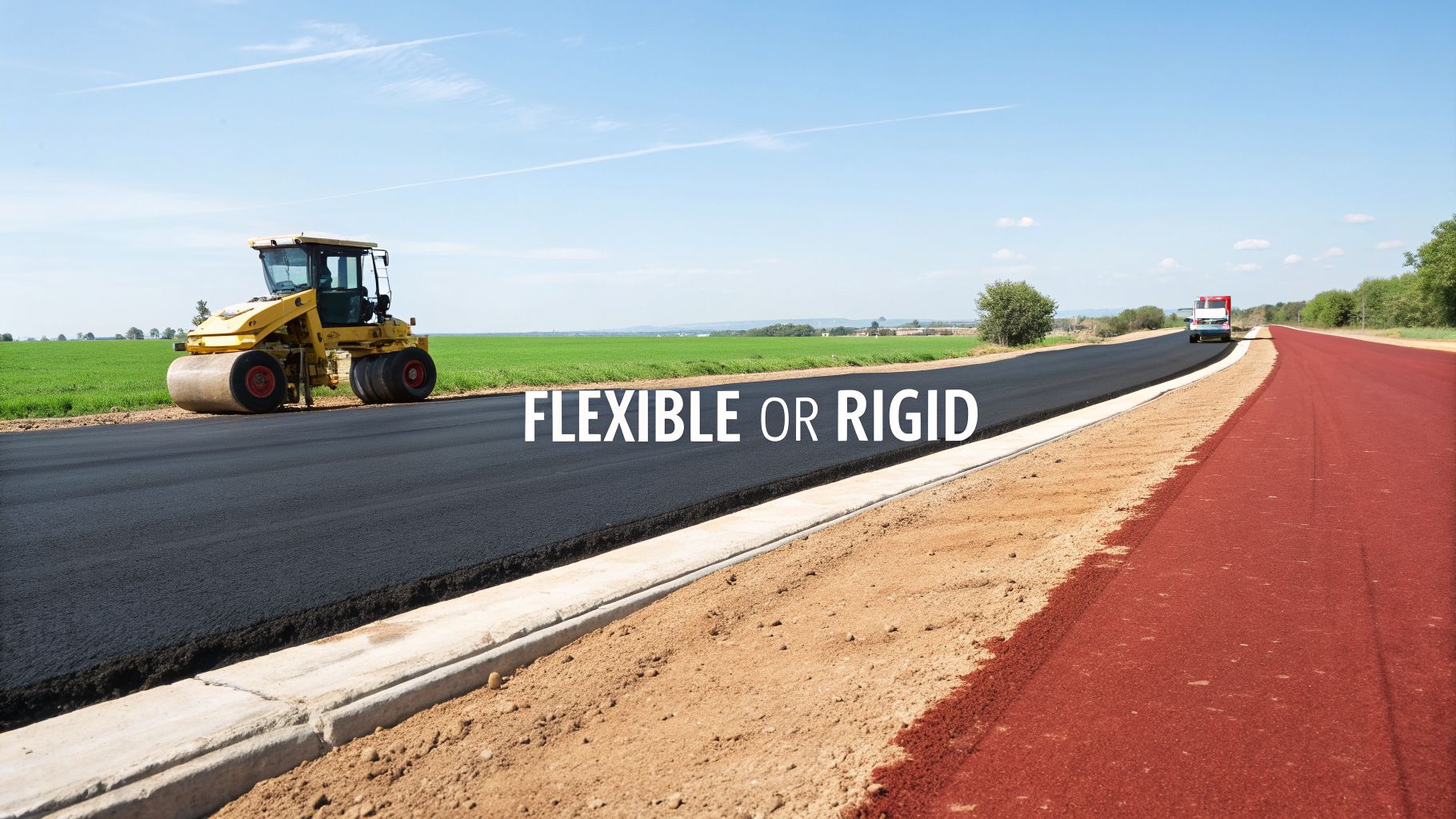
Flexible Pavements: The Layered Approach
Flexible pavements, which are typically asphalt, work like a team. They’re built in layers: a smooth asphalt surface on top, a base course of crushed rock, and often a sub-base layer below that. All of this sits on the prepared ground, which engineers call the ‘subgrade’.
When a truck drives over an asphalt road, the weight is spread down through each of these layers. The whole system is designed to bend or ‘deflect’ just a tiny bit under the load, distributing the stress before it reaches the soil. This built-in flexibility makes it a great choice for sites where the ground might not be perfect, as it can handle minor settlement without cracking.
Rigid Pavements: The Strength of a Single Slab
On the other hand, rigid pavements—usually steel-reinforced concrete—are the heavyweights. They act like that solid concrete garden slab. A thick, high-strength concrete slab does almost all the structural work by itself.
Because the slab is so stiff, it spreads vehicle loads over a very wide area of the ground underneath. This means it doesn’t rely as heavily on the strength of the underlying layers. It’s this brute strength that makes rigid pavements incredibly durable and perfect for areas with heavy, slow-moving traffic like industrial hardstands, container terminals, or busy loading docks.
At a Glance: Flexible vs. Rigid Pavement for NSW Developers
Choosing between asphalt and concrete involves balancing upfront costs, site conditions, traffic loads, and your long-term maintenance strategy. To make things clearer for your next private development in NSW, here’s a quick comparison.
| Characteristic | Flexible Pavement (e.g., Asphalt) | Rigid Pavement (e.g., Concrete) |
|---|---|---|
| Initial Cost | Generally lower upfront construction cost. | Typically higher initial construction cost. |
| Construction Time | Faster to build and can often be opened to traffic much sooner. | Slower to construct as it needs time for the concrete to cure and gain full strength. |
| Load Distribution | Spreads loads through its layers, making it well-suited for general car and truck traffic. | The stiff slab distributes loads over a very wide area, making it excellent for very heavy or static loads. |
| Maintenance | Needs more frequent but usually simpler repairs like crack sealing or patching. | Requires less frequent maintenance, but repairs like replacing a full slab can be more complex and expensive. |
| Best For | Residential streets, car parks, and light commercial access roads. | Industrial driveways, heavy-duty hardstands, loading bays, and high-traffic intersections. |
| Lifespan | Typically 15-20 years before needing major rehabilitation. | Can last 30-40+ years with a good maintenance program. |
There is no single “better” option. The right choice is always the one that’s better for your specific project. At Integra Consultants, we help you weigh the initial budget against the whole-of-life cost, considering exactly what kind of traffic the pavement will handle and the performance you need to deliver for decades to come.
Your Pavement is Only as Good as the Ground Beneath It
Before we even think about laying asphalt or pouring concrete, we have to talk about what’s holding it all up. The simple truth is, the most perfectly designed pavement will fail if its foundation is weak. We call this foundation the subgrade—it’s the natural soil your road or car park will sit on for the next few decades.
Think of it this way: building a strong pavement on a poor subgrade is like building a house on a sponge. It doesn’t matter how well-built the house is; if the ground gives way, the structure will crack and fail. Here in NSW, we see it all, from reactive clays that swell and shrink dramatically with moisture changes to soft, shifting sands near the coast.
Ignoring this fundamental layer is one of the most common—and costly—mistakes a developer can make. Simply assuming the ground is “good enough” without proper testing is a gamble you don’t want to take.
Why We Never Guess What’s Underground
At Integra Consultants, one of the first things we do on any pavement project is a proper geotechnical investigation. This isn’t just about digging a few holes for a quick look. It’s a scientific process to find out exactly what we’re building on.
We need to know the soil’s strength, what happens to it when it gets wet, and how it will hold up over the long run. This process gives us the hard data needed to create a design that is both cost-effective and built to last. Without it, any pavement design is just a shot in the dark.
Some of the key questions we answer are:
-
What type of soil is it? Is it clay, silt, sand, or something else? Each behaves very differently under the pressure of traffic and exposure to water.
-
How strong is the soil? This is where we figure out its load-bearing capacity, which directly tells us how thick your pavement layers need to be.
-
Is the soil ‘reactive’? Reactive clays, common across NSW, are notorious for causing ground movement, cracking pavements as they expand and contract with moisture.
A proper geotechnical investigation takes the guesswork out of the equation. It delivers the solid data that councils and certifiers demand, and it’s the only way to ensure your investment doesn’t literally sink into the ground.
Understanding the CBR Test in Simple Terms
One of the most important tools we use is the California Bearing Ratio (CBR) test. It might sound technical, but its purpose is simple: it measures the strength of your subgrade soil. It tells us precisely how much pressure the ground can take before it starts to give way.
Imagine pushing your thumb into different materials. You could easily make a dent in soft mud (which would have a low CBR value), but you’d get nowhere pressing on hard, dry earth (a high CBR value). The CBR test gives us a number that defines this strength, and that number is absolutely critical for a reliable pavement design for private sectors/developers in NSW (flexible and rigid).
A low CBR value signals weak ground, meaning the pavement structure has to be thicker and stronger to spread the load. A high CBR, on the other hand, means the ground is already strong, so we can design a more economical, thinner pavement. This one number has a massive impact on material costs and your overall project budget.
How NSW Site Features Impact Your Design
But it’s not just about the soil itself. Other common site features in NSW can dramatically influence your pavement’s design, cost, and lifespan. For example, the slope of the land affects how water runs off and whether it seeps into the subgrade, weakening it from below. The presence of large trees is another big one, as their roots can suck moisture out of the ground, causing settlement and cracking nearby.
Shallow groundwater is another classic problem, as it can saturate the subgrade and drastically reduce its strength. Understanding how all these elements work together is what separates a successful project from a failure. You can learn more about how we untangle these complex relationships in our insights on ground-structure interaction analyses. This is where our practical experience really counts—we don’t just analyse the soil in a vacuum; we look at the entire site to design a pavement that stands up to every potential risk.
Designing for Reality: Traffic Load and Project Lifespan
A pavement for a quiet residential cul-de-sac is a world away from an access road for a bustling industrial warehouse. It seems obvious, but a common mistake we see is a ‘one-size-fits-all’ approach. This either leads to spending far too much on an over-engineered road or, even worse, building a surface that fails prematurely under real-world strain.
Any robust pavement design must account for how it will be used—not just today, but for its entire intended life. At Integra Consultants, we don’t guess. We calculate the cumulative impact of traffic over the pavement’s design lifespan. It’s a non-negotiable step in any pavement design for private sectors/developers in NSW (flexible and rigid), ensuring the asset you’re building is both cost-effective and fully compliant.
Predicting Wear and Tear Accurately
To design a road that lasts, we first need a clear picture of the load it will actually carry. This starts with a conversation with you, the developer, to define the purpose of the area. Will it be mostly passenger cars, or will it need to support the daily grind of heavy vehicles like garbage trucks and delivery fleets?
This is where a concept required by authorities like Austroads comes into play: ‘Equivalent Standard Axles’ (ESAs). It might sound technical, but the idea is simple. It converts the mix of light cars and heavy trucks into a single, predictable number that represents the total wear and tear over the pavement’s life.
Think of it like this: a single, fully loaded semi-trailer can cause the same pavement damage as thousands of cars. The ESA calculation allows us to add up all that varied impact into one figure, which then directly tells us how thick and strong the pavement layers need to be.
Designing a pavement without a proper traffic assessment is like packing for a trip without knowing the destination or the weather. You might get lucky, but you’ll more than likely be unprepared for the real conditions, leading to serious problems down the road.
Getting the Balance Right for Your Project
Our role as your engineer is to find that sweet spot between cost and durability. We work closely with you to ensure the design is neither:
-
Over-engineered: Building a pavement far stronger than needed wastes significant money on unnecessary materials and deeper construction.
-
Under-engineered: This is by far the bigger risk. A pavement that’s too weak might look fine on day one but will crack, rut, and fail prematurely. This leads to costly repairs, operational headaches, and potential compliance battles with the council.
While government reports like NSW Treasury’s analysis of the housing market highlight significant private infrastructure investment, there’s a surprising lack of public data on how these privately-built pavements perform over time. This information gap makes experience-driven engineering judgement even more critical.
This is where our practical experience provides real value. We combine your project vision with our engineering knowledge to develop a defensible, efficient solution that satisfies council requirements and delivers genuine long-term performance. If the ground itself is a weak link, we can also advise on practical ways of improving the ground to support your structures.
Navigating Council Approvals and DBP Act Compliance
For any private developer in NSW, getting your pavement design signed off by the local council and certified under the Design and Building Practitioners (DBP) Act is often the final, most crucial hurdle. It’s more than just submitting drawings; it’s about proving, without a doubt, that your design is fully compliant.
This means ticking all the boxes: the council’s own Development Control Plans (DCPs), Australian Standards, and the overarching Austroads guidelines. A common headache for developers is discovering that each NSW council has its own specific preferences—for everything from material choices and drainage details to how they want drawings presented. This is where projects often get stuck in a frustrating loop of council feedback and costly resubmissions.
Speaking the Council’s Language
This is precisely where an experienced consultant proves their worth. Think of us at Integra Consultants as your technical translator. Our job is to bridge the gap between your project’s commercial goals and the council’s non-negotiable technical requirements. We do this by preparing clear, robust, and defensible engineering documentation that anticipates what the council engineers need to see.
We know what they’re looking for because we speak their language. We proactively address their likely questions on subgrade preparation, traffic load calculations (ESAs), and stormwater management, presenting the answers upfront in a format they recognise and trust. This cuts through the noise and streamlines the approval process.
The core of a compliant design boils down to getting these fundamentals right.
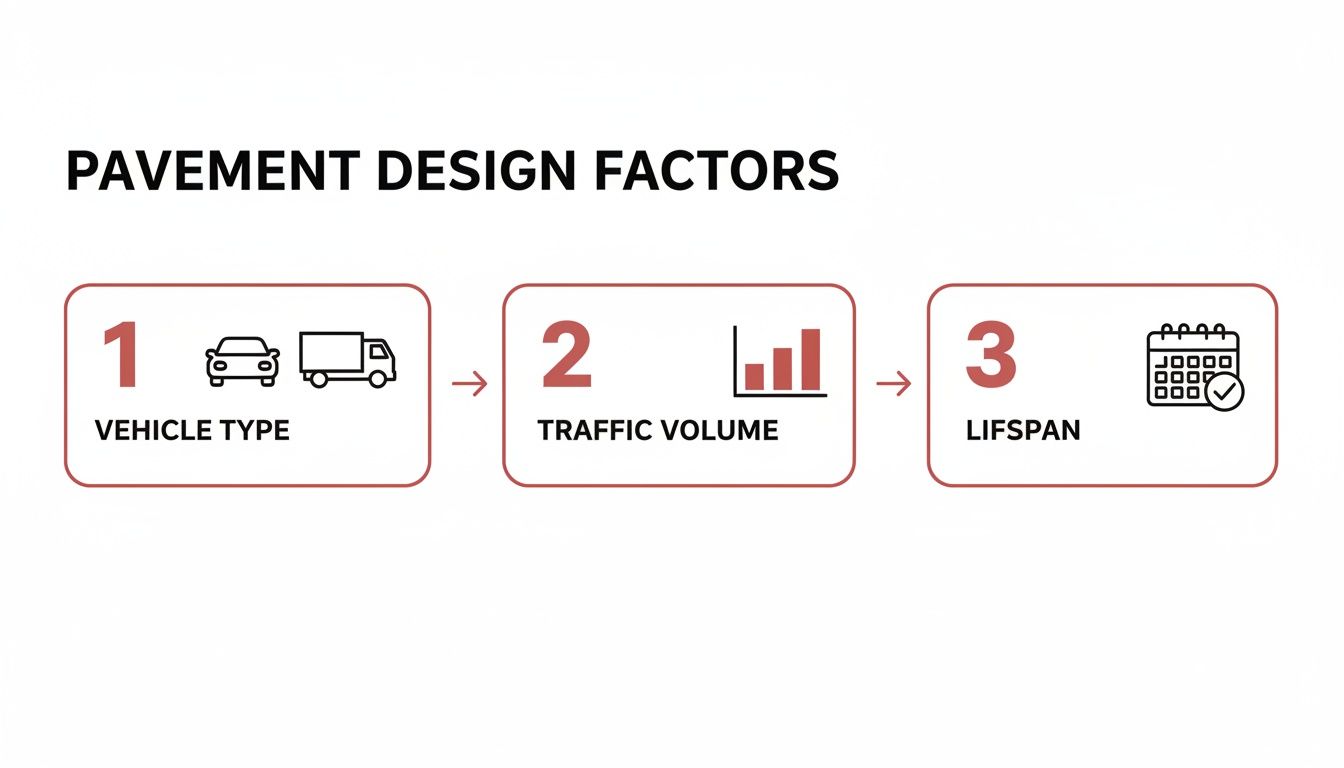
As you can see, a successful pavement design for private sectors/developers in NSW (flexible and rigid) isn’t based on one factor alone but is a careful balance of these key inputs.
Designing for Drainage and Long-Term Value
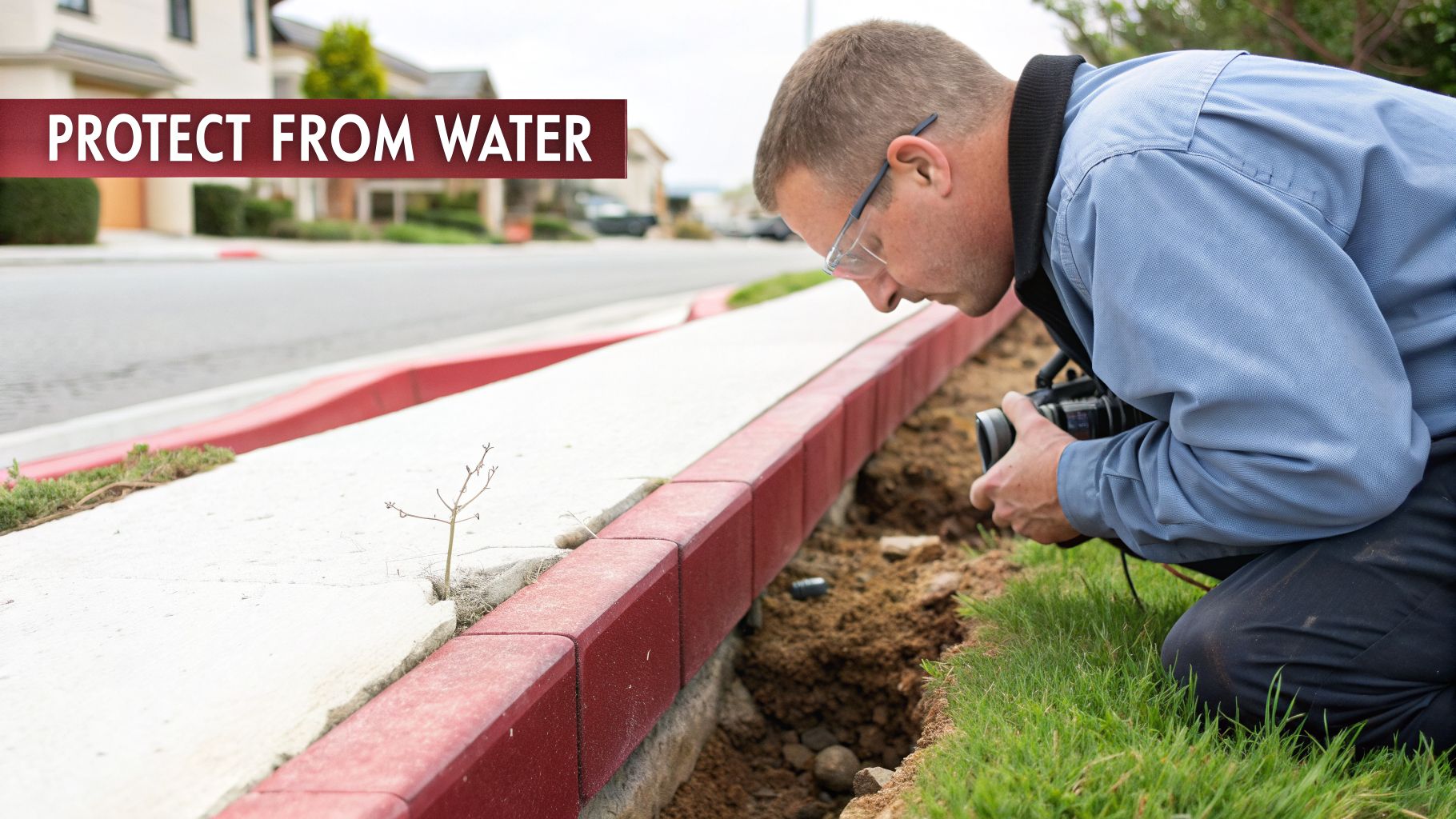
Think of your new pavement as a major asset for your development. And like any valuable asset, its biggest enemy is water. When water finds its way into the pavement layers or the ground beneath, it slowly but surely undermines the entire structure. The ground softens, cracks appear, and eventually, the pavement fails. That’s why a great pavement design is always a great drainage design first.
Thankfully, managing water doesn’t have to be complicated, but it is absolutely critical. We design every pavement to proactively channel water away from where it can do damage. This involves the obvious things you can see on the surface, as well as the hidden systems working tirelessly underground.
Smart Drainage Protects Your Investment
A well-thought-out design uses a few simple but powerful elements to keep the pavement structure dry and stable. These are non-negotiable fundamentals for any pavement design for private sectors/developers in NSW (flexible and rigid).
Here are the key elements we focus on:
-
Kerbs and Gutters: These are your first line of defence. They act as a barrier, collecting rainwater and funnelling it straight into the stormwater system. This stops water from pooling on the surface or soaking into the vulnerable edges of the pavement.
-
Subsoil Drains: These are the unsung heroes of pavement longevity. Essentially, they are perforated pipes laid in trenches filled with gravel alongside or under the pavement. Their job is to intercept any groundwater before it can saturate and weaken the all-important subgrade. On sloped sites or in areas with a high water table, these are an absolute must.
Proper water management is a cornerstone of civil engineering. If you’re dealing with more complex groundwater challenges on a project, such as in a deep basement, you can see how we approach them in our guide on deep excavation dewatering.
Thinking About Whole-of-Life Cost
While a smart design drastically cuts down on future repair bills, every pavement needs some care over its lifetime. Factoring this in from day one is how savvy developers achieve real long-term savings. The initial construction cost is just one piece of the puzzle; the ‘whole-of-life’ cost is what really impacts your bottom line.
“Considering maintenance from the start isn’t an extra cost; it’s a strategic decision. It allows you to budget predictably and avoid the surprise of major, expensive repairs down the road.”
The maintenance needs for flexible and rigid pavements are quite different, and this is something we help you weigh up during the design phase.
-
Flexible Pavement (Asphalt): This usually needs more frequent but smaller-scale maintenance. Think sealing minor cracks before they get bigger and let water in, or patching small areas of wear.
-
Rigid Pavement (Concrete): Generally needs less frequent intervention, but the repairs can be more substantial when required. Maintenance here is often about resealing the joints between slabs to keep water out or fixing any chipping (spalling) at the edges.
By balancing these long-term considerations at the very beginning, we help you make an informed decision that protects your investment and ensures your project stands the test of time.
Pavement Design FAQs for NSW Developers
If you’re a developer, builder, or project manager in NSW, you’ve probably got some practical questions about pavement design. We get it. Let’s run through some of the most common queries we hear at Integra Consultants and give you some straight answers.
How Much Does Pavement Design Cost?
It’s a fair question, but the honest answer is: it depends. The cost is tied to your project’s size, the complexity of the site, and the level of geotechnical investigation needed.
The key, though, is to see it as an investment, not a cost. Spending a little on a proper, site-specific pavement design for private sectors/developers in NSW (flexible and rigid) upfront is a tiny fraction of the cost of rebuilding a failed pavement or being forced into expensive rework by a council. It’s about avoiding major financial headaches down the track.
How Long Does Council Approval Take?
The timeline can be anything from a few weeks to several months. The waiting time really comes down to the specific council you’re dealing with, the scale of your development, and—most importantly—how clear and complete your submission is.
A well-prepared application with solid engineering justification is your fastest path to approval. At Integra Consultants, we know what councils are looking for, and we focus on giving them the clear, defensible documents they need to sign off without a lot of back-and-forth.
Submitting a thorough, professional design package is the single best way to minimise council approval timelines and avoid frustrating delays.
Can I Use a Standard Pavement Design for My Project?
For something incredibly simple, like a standard single-house driveway, some councils might have a ‘deemed-to-comply’ option. But for almost any other private development, the answer is a firm no. A one-size-fits-all design just doesn’t work in the real world.
Think about it – the soil strength, the types of vehicles that will use it, and how water drains away are unique to every single site. A tailored design isn’t a luxury; it’s essential for making sure your pavement is built to last and meets council standards.
Is Concrete Always Better for Heavy Traffic?
Not necessarily. It’s easy to assume rigid concrete is the only choice for heavy loads, but a well-designed flexible asphalt pavement can be engineered to handle heavy traffic effectively, especially when laid on a properly prepared base.
The right choice comes down to a ‘whole-of-life’ cost analysis. We have to look beyond the initial price tag and consider long-term maintenance, construction schedules, and your specific site conditions. Getting expert advice helps you weigh these factors properly. If your question wasn’t answered here, feel free to get in touch with our team.