


If you are planning to build a new home, renovate an existing property, construct a retaining wall, add a basement, or develop land in Australia, you may have been advised to obtain a geotechnical investigation report. One of the first questions many property owners ask is:
“How much does a geotechnical investigation cost?”
The answer depends on several factors, including the type of development, site conditions, investigation methods required, location, accessibility and the level of engineering assessment needed.
A geotechnical investigation is not simply a soil test. It is a professional assessment of the ground beneath a proposed development to understand how soil, rock and groundwater conditions may affect construction. The information obtained helps engineers make safer design decisions, reduce unexpected costs and minimise construction risks.
For property owners in Sydney and across NSW, understanding geotechnical investigation costs before starting a project can help with accurate budgeting and avoid costly surprises during construction.
Integra Consultants provides geotechnical engineering services for residential, commercial and civil projects, helping property owners understand their ground conditions and select an investigation scope suitable for their development.
What Is a Geotechnical Investigation?
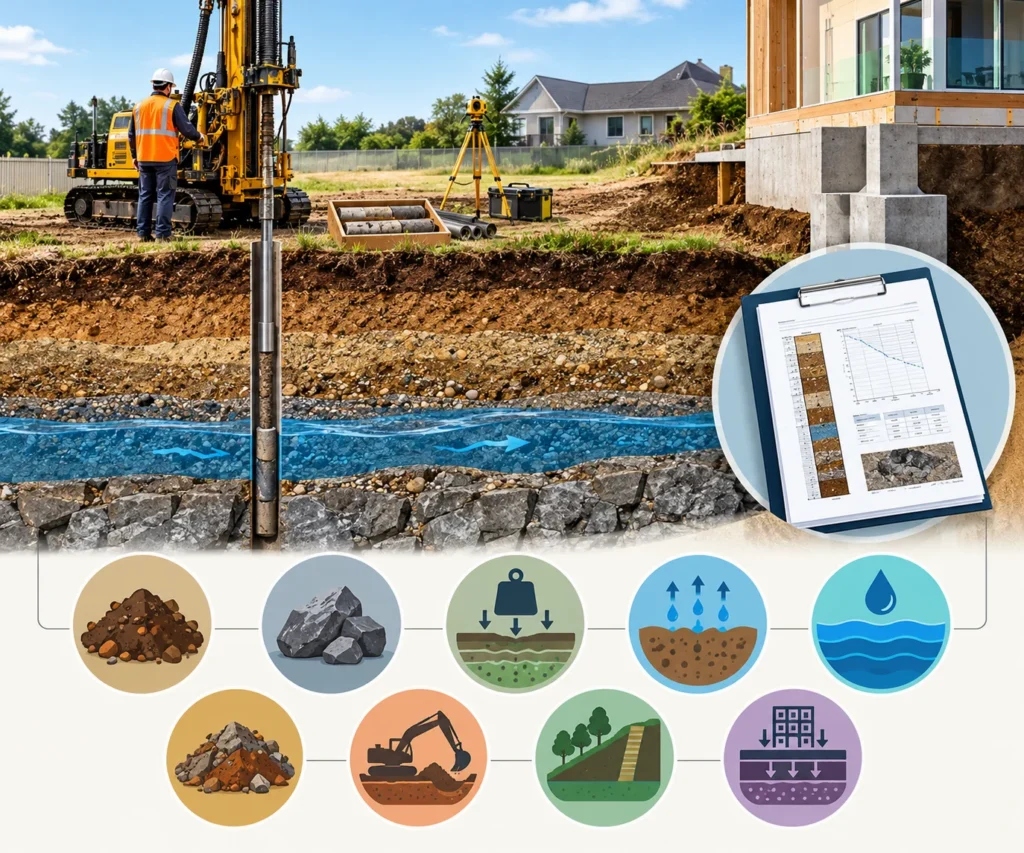
A geotechnical investigation examines the physical properties and behaviour of soil, rock and groundwater at a site. The purpose is to understand whether the ground can safely support a proposed structure and what construction challenges may exist.
Every building transfers loads into the ground. Although architects and structural engineers design the visible parts of a structure, the performance of the building depends heavily on the conditions below the surface.
A geotechnical investigation may assess:
- Soil type and depth
- Rock conditions and quality
- Soil strength and bearing capacity
- Soil movement caused by moisture changes
- Groundwater conditions
- Existing fill materials
- Excavation conditions
- Slope stability
- Potential settlement risks
The findings are presented in a geotechnical report, which provides recommendations for foundation design, excavation, retaining structures, drainage and construction methods.
Because ground conditions can vary significantly even between neighbouring properties, a site-specific investigation is usually more reliable than relying only on general geological information or nearby reports.
Average Geotechnical Investigation Cost in Australia
There is no fixed price for a geotechnical investigation because every site has different requirements. A simple residential assessment may require only limited testing, while a large development with deep excavation may require extensive drilling, laboratory testing and engineering analysis.
Typical cost ranges in Australia may include:
| Project Type | Approximate Cost Range (AUD) |
|---|---|
| Small residential soil investigation | $800 – $2,000 |
| House extension or renovation assessment | $1,000 – $3,000 |
| New residential construction | $1,500 – $4,000 |
| Retaining wall investigation | $1,000 – $3,500 |
| Swimming pool investigation | $1,000 – $3,000 |
| Basement excavation assessment | $3,000 – $10,000+ |
| Multi-storey or commercial development | $5,000 – $20,000+ |
These figures are general estimates only. The final geotechnical investigation cost depends on the complexity of the project and the specific conditions found at the site.
A professional consultant will usually review the project requirements first and recommend an appropriate investigation scope rather than applying the same testing package to every property.
Why Do Geotechnical Investigation Costs Vary?
The cost of a geotechnical investigation is influenced by several important factors. Understanding these factors helps property owners understand what they are paying for and why two properties may receive different quotes.
1. Type and Size of the Development
The proposed development is one of the biggest factors affecting investigation cost.
A small single-storey home generally requires less investigation compared with a large commercial building or deep basement excavation.
For example, a residential footing investigation may only require:
- Site inspection
- Limited soil testing
- Soil classification
- Basic foundation recommendations
However, a multi-storey development may require:
- Multiple boreholes
- Deeper drilling
- Rock assessment
- Groundwater monitoring
- Settlement analysis
- Excavation stability assessment
Larger and more complex projects require more detailed information because the consequences of unexpected ground conditions are greater.
2. Site Location and Accessibility
The physical location and accessibility of a property can influence the overall cost of investigation.
Some sites are straightforward to access, allowing drilling equipment and testing equipment to operate efficiently. Others may present challenges such as:
- Narrow access areas
- Steep slopes
- Limited working space
- Dense urban surroundings
- Nearby buildings
- Traffic restrictions
For example, a suburban block with easy vehicle access may require less preparation compared with a difficult inner-city site where equipment movement is restricted.
Additional requirements such as traffic control, specialised equipment or manual investigation methods may increase the cost.
3. Soil and Ground Conditions
The actual conditions beneath the site are another major factor affecting geotechnical investigation cost.
Different ground conditions require different levels of assessment.
Common conditions found across Australia include:
Rock
Rock may provide strong foundation support, but its depth, strength, weathering and fractures need to be understood. If excavation encounters hard rock, additional investigation such as rock coring may be required.
Clay Soil
Clay soils can expand and shrink as moisture levels change. Reactive clay may affect foundation movement and requires appropriate assessment.
Sandy Soil
Loose sandy soils may present challenges related to settlement, erosion or groundwater.
Imported Fill
Sites containing uncontrolled fill may have variable ground conditions. Additional investigation may be required to determine whether the material is suitable for supporting structures.
Groundwater
Water conditions can significantly influence construction, particularly for basements and deep excavations. Monitoring or additional assessment may be required where groundwater is present.
Because subsurface conditions cannot be fully confirmed from surface appearance alone, investigation helps identify potential issues before construction begins.
4. Investigation Methods Required
Different projects require different investigation methods. The selected methods directly influence the cost of the investigation.
Common geotechnical investigation methods include:
Boreholes
Boreholes allow engineers to examine soil and rock conditions at greater depths. They are commonly used for:
- Buildings
- Basements
- Commercial developments
- Deep foundations
Test Pits
Test pits provide direct observation of shallow soil layers and are useful for:
- Earthworks
- Fill assessment
- Accessible residential sites
Hand Augering
Hand augering is commonly used for smaller residential investigations where shallow soil information is required.
Dynamic Cone Penetrometer (DCP) Testing
DCP testing provides information about soil resistance and is often used for:
- Residential footing assessments
- Pavement investigations
- Fill evaluation
Standard Penetration Testing (SPT)
SPT provides information about soil strength and is often performed during borehole investigations.
Rock Coring
Rock coring is used when rock quality, strength and fractures need to be assessed.
Laboratory Testing
Collected soil samples may require laboratory testing to determine:
- Soil classification
- Moisture content
- Plasticity
- Strength characteristics
- Reactivity
- Other engineering properties
Not every project requires all these methods. A competent geotechnical consultant selects investigation techniques based on the actual engineering requirements of the site.
For readers who want to explore the technical principles behind these assessments, MIT OpenCourseWare’s Advanced Soil Mechanics course provides educational material on soil classification, groundwater flow, soil strength, bearing capacity, settlement, and field and laboratory methods for evaluating soil properties.
What Is Included in a Geotechnical Investigation Cost?
When property owners receive a quotation for a geotechnical investigation, it is important to understand what services are included. The cost is not only for collecting soil samples; it covers professional assessment, engineering interpretation and preparation of recommendations suitable for the proposed development.
A typical geotechnical investigation may include the following stages:
Initial Project Review
Before visiting the site, the geotechnical consultant reviews available information about the project, including:
- Proposed building plans
- Site survey information
- Development type
- Expected structural loads
- Excavation requirements
- Previous geotechnical reports, if available
- Geological information
This step helps determine the appropriate investigation approach and prevents unnecessary testing.
A house extension, for example, may require a different investigation compared with a basement excavation or commercial development.
Site Inspection
A site inspection allows the engineer to assess visible conditions and identify possible risks.
During the inspection, the consultant may review:
- Existing structures
- Surface drainage
- Slope conditions
- Signs of erosion
- Cracking or ground movement
- Vegetation influence
- Access limitations
- Evidence of previous filling or excavation
Visible site conditions often provide important information about what may exist below ground.
Field Investigation and Testing
Fieldwork forms a major part of the investigation cost. Depending on the project, the consultant may use:
- Boreholes
- Test pits
- Hand augers
- Cone penetration testing
- Dynamic cone penetrometer testing
- Rock coring
The purpose is to understand the soil and rock profile beneath the proposed construction area.
The number and depth of investigation locations depend on:
- Site size
- Development complexity
- Expected ground conditions
- Structural requirements
- Risk level
A larger or more complex project generally requires more extensive field investigation.
Laboratory Testing
In some cases, collected soil samples are sent to a laboratory for further testing.
Laboratory testing may determine:
- Soil classification
- Moisture content
- Plasticity characteristics
- Soil reactivity
- Strength properties
- Compaction characteristics
The required laboratory tests depend on the engineering questions that need to be answered.
Not every project requires extensive laboratory testing. A professional geotechnical engineer selects tests that provide useful information for the specific development.
Engineering Analysis and Reporting
After completing fieldwork and testing, the consultant analyses the results and prepares a geotechnical report.
The report may include recommendations relating to:
- Foundation design
- Site classification
- Allowable bearing pressure
- Settlement considerations
- Excavation conditions
- Retaining wall design
- Groundwater management
- Earthworks and drainage requirements
The engineering interpretation is a key part of the investigation cost because raw test results alone do not explain how the ground will behave under a proposed structure.
Why Is a Geotechnical Investigation Worth the Cost?
Some property owners consider a geotechnical investigation an additional expense. However, it is often one of the most valuable steps in the early stages of construction planning.
The purpose of the investigation is not only to identify soil conditions but also to reduce uncertainty and allow better decisions before construction begins.
1. Helps Prevent Foundation Problems
The foundation is the connection between a building and the ground beneath it.
If soil conditions are poorly understood, a structure may experience:
- Uneven settlement
- Cracking
- Structural movement
- Foundation failure
A geotechnical investigation helps identify issues such as weak soil, reactive clay, variable fill or unsuitable founding conditions.
This allows structural engineers to design foundations that are appropriate for the actual site conditions.
2. Reduces Unexpected Construction Costs
Unexpected ground conditions can significantly affect construction budgets.
Examples include:
- Hard rock requiring additional excavation
- Groundwater affecting basement construction
- Poor-quality fill requiring removal or treatment
- Unstable soil requiring additional support
Identifying these conditions before construction allows project teams to plan appropriately and reduce expensive changes later.
3. Supports Safer Excavation
Excavation can affect workers, neighbouring properties and existing structures.
A geotechnical assessment helps determine:
- Soil stability
- Excavation risks
- Ground support requirements
- Potential groundwater issues
This information is particularly important for:
- Basement construction
- Deep excavations
- Retaining walls
- Developments close to existing buildings
Early engineering advice allows safer construction planning. For basement and deep excavation projects, these findings can also inform deep excavation, dewatering and shoring design.
4. Improves Design Decisions
Architects and structural engineers rely on geotechnical information when developing designs.
The investigation findings can influence:
- Building location
- Foundation type
- Excavation depth
- Retaining solutions
- Drainage design
Designing based on actual ground conditions is generally more reliable than making assumptions.
5. Helps With Approval and Documentation Requirements
Depending on the location and project type, councils, certifiers and approval authorities may request geotechnical documentation.
A professional geotechnical report can support:
- Development applications
- Construction documentation
- Engineering certification
- Design approvals
Requirements vary between councils, so property owners should confirm what documentation is needed for their specific project.
Geotechnical Investigation Cost in Sydney and NSW
Sydney and surrounding NSW regions contain a wide variety of geological conditions. This variation means geotechnical investigation costs can differ significantly between properties.
Common ground conditions across Sydney include:
- Sandstone
- Shale
- Clay soils
- Coastal sands
- Weathered rock
- Imported fill
A property located on sandstone may require rock assessment, while a site containing reactive clay may require additional soil testing.
Even nearby properties can have different subsurface conditions due to:
- Previous construction
- Excavation history
- Imported fill
- Natural geological changes
- Drainage patterns
For this reason, a previous report from a neighbouring property may provide useful background information but may not replace a site-specific investigation.
A local geotechnical consultant understands regional conditions and can recommend an investigation scope appropriate for the site.
How Can Property Owners Reduce Geotechnical Investigation Costs?
While geotechnical investigation costs depend largely on site conditions, property owners can take steps to make the process more efficient.
Provide Project Information Early
Providing accurate information helps consultants design the right investigation scope.
Useful information includes:
- Architectural drawings
- Survey plans
- Proposed excavation details
- Previous reports
- Site history
Choose the Right Level of Investigation
A common misconception is that more testing is always better.
The goal is not unnecessary testing but obtaining enough information to make reliable engineering decisions.
A professional consultant will recommend testing based on:
- Project requirements
- Site risks
- Construction methods
- Ground conditions
Avoid Delaying the Investigation
Waiting until construction planning is advanced can create problems.
Early investigation allows information to influence:
- Architectural design
- Foundation selection
- Construction planning
- Budget estimates
Making changes after designs are completed can be more expensive.
How Long Does a Geotechnical Investigation Take?
The timeframe depends on project complexity, site access, testing requirements and reporting needs.
A typical residential investigation may involve:
Site Preparation and Review
Several days may be required to review information and organise fieldwork.
Field Investigation
Site testing may take one day or several days depending on the scope.
Laboratory Testing
Additional time may be required if soil samples need laboratory analysis.
Report Preparation
The final geotechnical report is prepared after reviewing all results and completing engineering assessment.
Simple residential investigations may be completed relatively quickly, while larger developments involving deep excavation, groundwater monitoring or complex geology may require more time.
Planning the investigation early helps avoid delays during design and approval stages.
Frequently Asked Questions About Geotechnical Investigation Cost
How much does a geotechnical investigation cost in Australia?
The cost varies depending on project type and site conditions. A residential investigation may commonly range from approximately $1,000 to $4,000, while complex commercial or excavation projects may cost significantly more.
The final price depends on investigation depth, testing requirements, accessibility and reporting complexity.
Is soil testing included in a geotechnical investigation?
Yes, soil testing is often included as part of a geotechnical investigation. However, the specific tests performed depend on the project requirements and ground conditions.
Some projects may require only basic field testing, while others may need laboratory analysis and deeper investigation.
Do all building projects require a geotechnical report?
Not every project requires the same level of geotechnical assessment.
A report is more commonly required for projects involving:
- New construction
- Structural extensions
- Excavations
- Retaining walls
- Swimming pools
- Sloping sites
- Ground movement concerns
Requirements depend on the project, location and approval requirements.
Can I use my neighbour’s geotechnical report?
A neighbouring property report may provide useful information about local geology, but it may not accurately represent your site.
Ground conditions can change over short distances, and different developments create different engineering requirements.
A site-specific assessment provides more reliable information for design.
Is the cheapest geotechnical investigation the best option?
Not always.
A lower-cost investigation may appear attractive, but an incomplete assessment can leave important risks unidentified.
A quality investigation should provide:
- Appropriate testing
- Clear engineering interpretation
- Practical recommendations
- Suitable information for the design team
The goal should be value and reliability rather than simply selecting the lowest price.
Does a geotechnical report guarantee no construction problems?
No investigation can remove all uncertainty.
A geotechnical report is based on:
- Tested locations
- Available information
- Proposed design details
Unexpected conditions may still occur during construction. However, a properly prepared investigation significantly reduces avoidable risks by identifying important ground conditions early.
Choose Integra Consultants for Geotechnical Investigation Services in Sydney
Understanding the ground beneath your property is an essential part of successful construction planning.
A professional geotechnical investigation helps identify soil, rock and groundwater conditions before they become expensive construction issues. It allows architects, engineers, builders and property owners to make informed decisions based on reliable site information.
Integra Consultants provides geotechnical investigation services for residential, commercial and civil projects across Sydney and NSW.
Our team can assist with:
- Residential soil investigations
- Geotechnical reports
- Foundation recommendations
- Excavation assessments
- Retaining wall investigations
- Ground condition assessments
Whether you are planning a new home, renovation, basement, retaining wall or larger development, our team can help determine the appropriate investigation scope for your project.
Contact Integra Consultants to discuss your geotechnical investigation requirements.
Visit us: Unit 22, 108 Dunning Avenue, Rosebery NSW 2018
Call: +61 2 8764 6460
Email: info@integraconsultants.com.au


